Can You Keep a Monk Parakeet in a Condo? Noise Levels, Smell, Mess and Keeping the Neighbours Happy
 Written by the NokMonk team, monk parakeet breeders in ThailandUpdated 12 Sept 2026Read time 13 min
Yes, a monk parakeet can live in a condo. A breeder explains how loud they really are, how to handle smell and mess, and how to stay on good terms with neighbou
The question I get asked most often these days has nothing to do with colour or price. It is "I live in a condo, can I keep a monk parakeet?" Most new bird owners no longer live in a house with a garden. They want a parrot that talks, tames well and is a manageable size, but they worry the noise will carry through the wall and end up as a complaint with building management. This article is my honest answer, drawn from years of keeping and breeding monk parakeets, first in a house and later in a condo unit shared with the birds themselves.
Can a monk parakeet live in a condo?
Yes, and among medium sized parrots it is one I recommend for condo living over many other species. But let me be upfront: this is not a quiet bird. You will need to put more effort into noise management and cleanliness than someone living in a detached house.
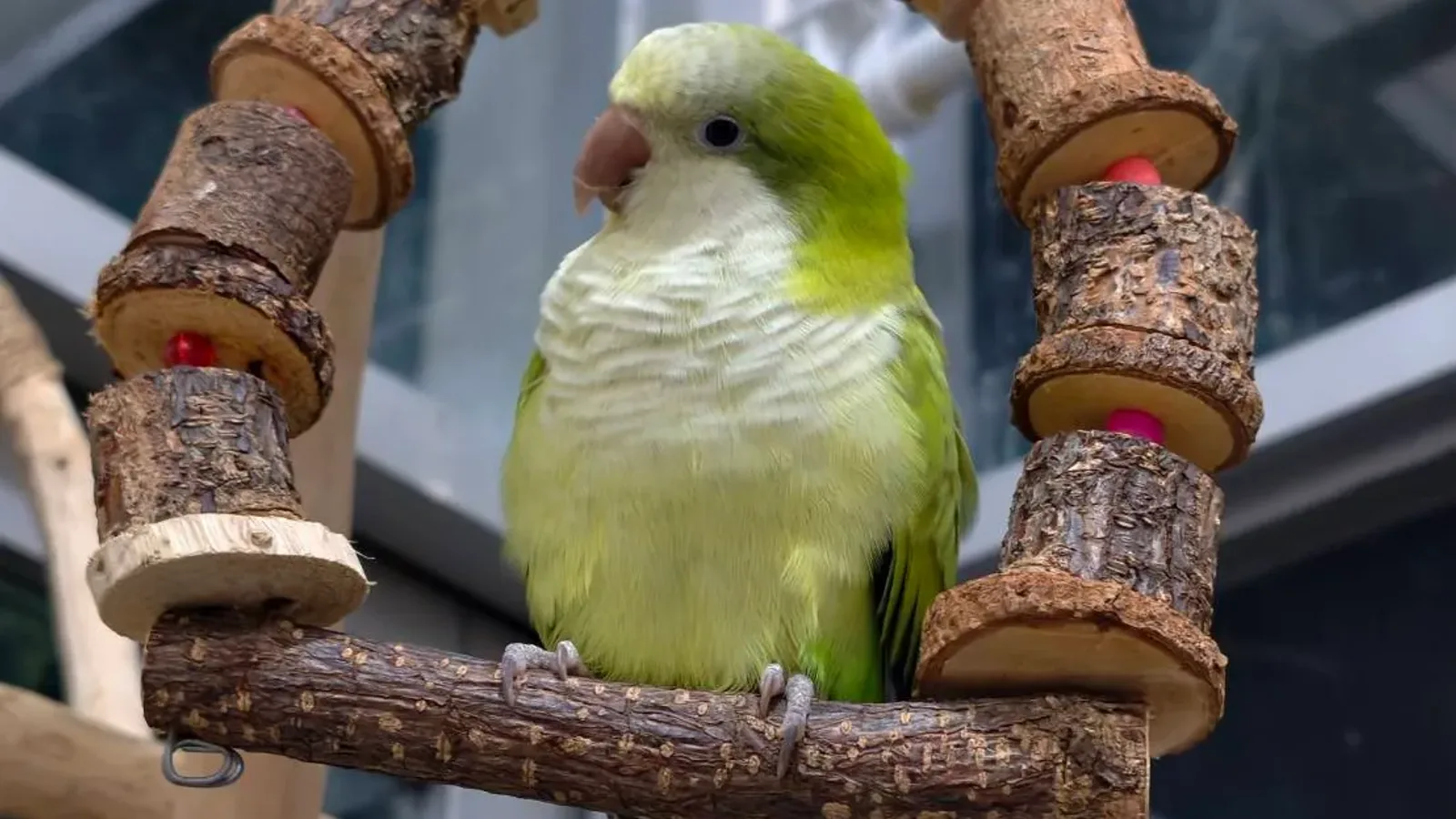
The reason monk parakeets suit condo life comes down to size and temperament. They measure roughly 28 to 30 cm and weigh around 90 to 120 g, so they do not need a cage anywhere near as large as a big parrot. They eat modestly, their droppings do not smell the way a large parrot's do, and most importantly they are clever enough to learn your routine. In the wild the monk parakeet lives in large, noisy flocks, and that social wiring comes with the bird. Living with people, it treats your household as its flock. Give it enough of your time and it will not call out constantly the way a bird left alone all day does.
The downside you must accept before deciding is this. If you leave at 7 in the morning and come home at 8 at night every day, leaving the bird alone in a silent room, a monk parakeet will start contact calling and may eventually develop feather plucking. That is not a condo problem. It is a time problem, and it will affect your neighbours directly.
Are parrots loud, and how does a monk parakeet compare?
Every parrot is loud. There is no such thing as a silent parrot. The monk parakeet sits in the middle of the range. It is clearly louder than a cockatiel or a lovebird, but nowhere near a sun conure, a cockatoo or a macaw. Those are in a different league entirely.
A monk parakeet makes 2 main kinds of sound. The first is a low chatter and mumble it keeps up all day when it is content. Close a bedroom door and you can barely hear it. The second is the alarm or contact call, a short, sharp screech that goes straight through a wall. You will hear it when the bird is startled, when it is calling for you, and in the early morning and late afternoon, which are the natural times for a flock to make itself heard.
From the many birds I have kept, those hand raised from chicks and given plenty of human company screech far less than birds bought as adults, simply because they do not have to scream for attention. As for sex, I have never seen a difference clear enough to call. Some hens are extremely quiet, some cocks are too. It comes down to individual personality and how the bird is raised.
| Parrot species | Overall noise level | What bothers neighbours | Condo suitable? |
|---|---|---|---|
| Lovebird | Low to medium | High pitched, frequent chirping, does not carry far through walls | Yes |
| Cockatiel | Low to medium | Whistling, morning contact calls | Yes |
| Monk parakeet | Medium | Short screeches in bursts, chatter all day | Yes, with training and enough time |
| Sun conure | High | Long, piercing, sustained screeching | Not really |
| Cockatoo | Very high | Extremely loud screams that carry across several floors | No |
This table comes from my own experience with these birds, not from decibel readings. Individual birds vary a great deal, but the overall picture holds.
When does a monk parakeet call, and how do you reduce the noise?
Monk parakeets are loudest at 2 times of day: shortly after waking, roughly 6 to 8 in the morning, and before dusk, roughly 5 to 6 in the evening. Beyond that, they call when startled, when they see you and want out of the cage, or when they have been left alone in silence for too long.
Here is what has genuinely worked for me in a condo, in the order I would apply it.
- Cover the cage at night and uncover it later in the morning. Monk parakeets wake with the light. If the cover is thick enough, the bird stays quiet until you lift it. On workdays I uncover around 7:30, so the morning chatter lands when most neighbours are already up.
- Give the bird at least 2 hours out of the cage every day. A bird that gets to climb, play and sit on your shoulder while you work screeches far less. Most contact calling comes from boredom and wanting to be near people.
- Do not respond to screeching. If the bird screams and you rush over, it learns that screaming works. Wait for 3 to 5 seconds of silence, then go in and praise or treat immediately. Do this consistently for 2 to 3 weeks and you will see results.
- Answer quiet chatter with quiet chatter. When the bird mumbles or talks, reply in a soft voice. It learns that a quiet voice gets a response too. This is why a monk parakeet that talks well usually screams less.
- Leave some low background sound on when you are out. A radio or soft music stops the room from feeling unnaturally silent. I prefer talk radio over music, because Quaker parrots love listening to human voices.
- Rotate the toys. Offer wooden chew toys and foraging toys, and swap them every 3 to 4 days. A bird busy chewing is a bird not calling.
Two things you must never do. Do not shout at the bird or bang the cage when it screams. To a parrot, your loud noise is a reply, and it will screech with even more enthusiasm. And do not cover the cage all day just to keep it quiet. The bird will become stressed and end up plucking its feathers.

Do monk parakeets smell?
The bird itself has almost no smell. Put your nose to its feathers and you get a faint powdery, seedy scent and nothing more. The "bird smell" people imagine actually comes from an unwashed cage tray, fresh food left to spoil and water that has not been changed.
Monk parakeet droppings are small, dry quickly and carry none of the sharp odour of a mammal's. That said, in a condo with the air conditioning running all the time and no airflow, a stale smell will build up if the tray sits for more than 2 to 3 days. My routine is to line the tray with newspaper or cage liner and change it daily, then wash the tray with water and a splash of vinegar every 3 days.
What really does smell is fruit and vegetables the bird has not finished, especially papaya, banana and boiled corn. In an air conditioned room they may not look spoiled, but the smell rises fast. Remove leftovers within 2 to 3 hours of serving. Pellets and dry seed have practically no odour at all.
Do the feathers make the room messy?
Yes, absolutely, but it is manageable. Monk parakeets produce far less feather dust than cockatiels and cockatoos. What you will get is small drifting down feathers, seed husks flicked out of the cage and splinters from chewed wooden toys scattered in a radius of about 1 metre around the cage.
During the moult, 1 or 2 times a year, feather loss picks up noticeably for 2 to 4 weeks. This is where a condo with tiled or laminate flooring wins, because it sweeps up far more easily than carpet. If your unit is carpeted, put a plastic sheet or a mat under the cage from day one.
What I do routinely in the condo:
- Use a seed guard around the cage, or choose a cage with a splash panel at the base. This cuts the debris around the cage by more than half.
- Switch from a seed mix to pellets as the main diet, with seed as a treat only. Dust and husks drop dramatically.
- Vacuum around the cage every other day. If you use a robot vacuum, schedule it for when the bird is inside the cage. Some monk parakeets are frightened of it, others want to climb down and ride it.
- Keep the cage away from the air conditioning vent, so the draught does not blow feathers around the room and the bird does not fall ill from cold air blowing straight at it.
- Run an air purifier. It helps with fine feather dust, especially if anyone in the household is already sensitive to dust.
The special caution in a closed room is for anyone in the home with respiratory allergies. Before committing, spend 2 or 3 sessions handling a monk parakeet at a friend's place or at a breeder. You will find out quickly whether you react.
What cage size suits a monk parakeet in a condo?
The smallest cage I will accept for a single monk parakeet is 60 cm wide, 45 cm deep and 60 cm tall. If you have the floor space, move up to 80 x 60 x 100 cm. The bird can stretch its wings fully and climb properly, and calling out of frustration drops off.
Bar spacing must not exceed 1.5 cm, because monk parakeets love to push their heads through gaps. Choose a cage with a door that latches firmly. This is an expert lock picker of a bird. I have had one open a standard latch within 2 days, and I had to add a spring latch and a clip to keep it in.
| Number of birds | Minimum cage (W x D x H) | Recommended size | Approximate cage price |
|---|---|---|---|
| 1 bird | 60 x 45 x 60 cm | 80 x 60 x 100 cm | 1,500 to 4,000 THB |
| 2 birds | 80 x 60 x 80 cm | 100 x 70 x 120 cm | 3,500 to 7,000 THB |
| Travel cage | 35 x 25 x 40 cm | Temporary use only, no more than 2 to 3 hours | 400 to 1,200 THB |
Cage prices vary with material and where they are made. A powder coated steel cage is far cheaper than stainless steel, but monk parakeets are serious chewers, and a cheap coated cage can start flaking within a year. If the budget allows, go for a quality coating or straight to stainless steel. It pays off over the long run.
For placement, I suggest a corner with the cage against at least 1 wall. The bird feels safer there than in the middle of the room. Set the cage at about chest height. Any higher than your head and the bird starts to feel it outranks you. Avoid putting it against a wall you share directly with a neighbour. If you have a wall that borders the common corridor or your own bathroom, use that side instead.

Which bird to choose for condo life
If you are set on keeping one in a condo, start with a hand fed chick of about 6 to 8 weeks that is learning to eat on its own, or a recently weaned youngster that is already tame. I do not recommend an adult that has never been tamed. Birds in that group contact call and startle screech far more often.
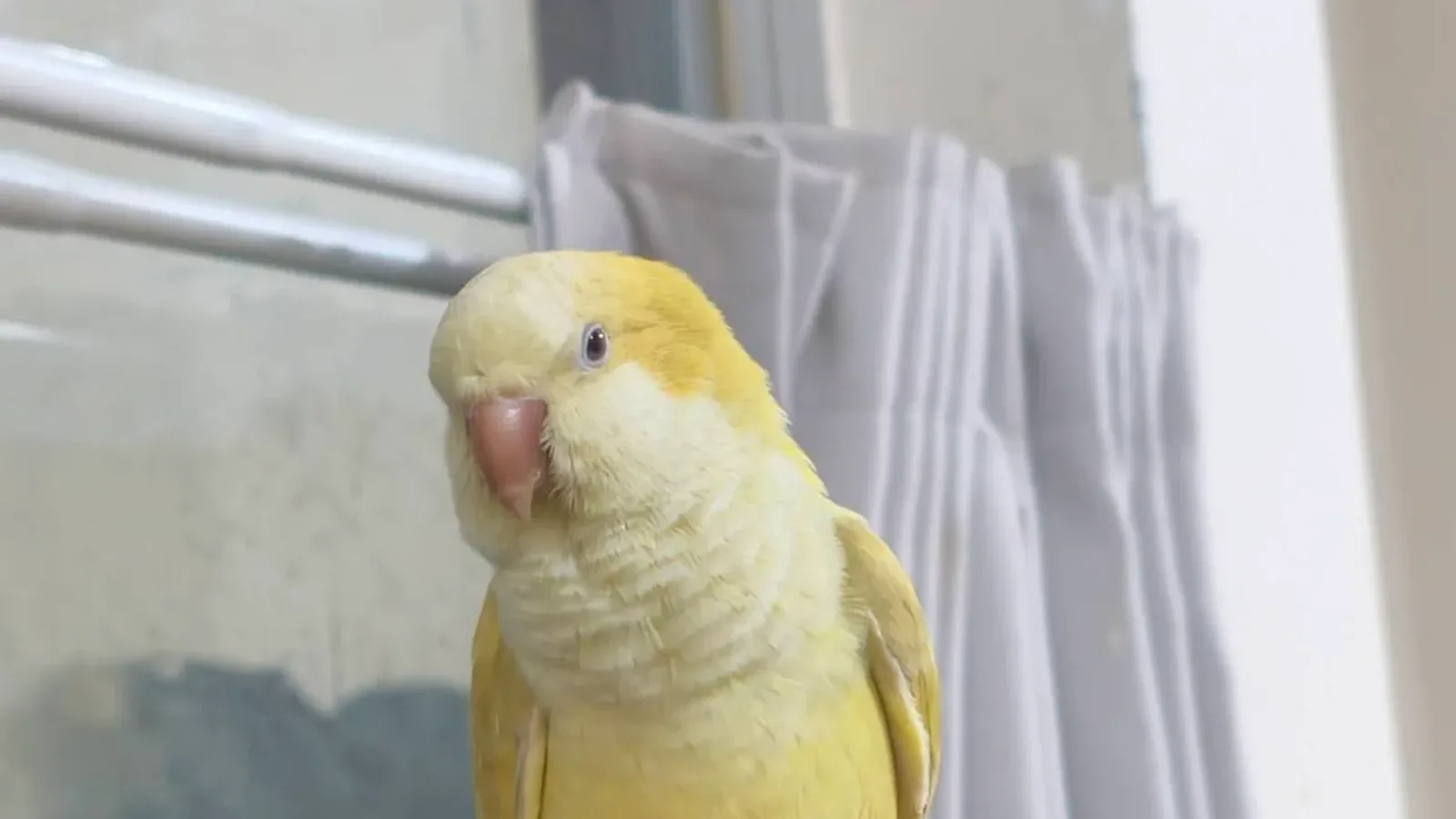
Colour has no effect on noise. A standard green, a blue or an Opaline are all equally vocal, so choose on budget and taste. At current Thai market prices, a standard green hand fed chick runs 5,000 to 9,000 THB, a green split 10,000 to 16,000 THB, a blue 15,000 to 25,000 THB, and Opaline, Turquoise, Lutino and combination colours 20,000 to 40,000 THB. These figures move with the season, how tame the bird is and the parents' genetics, so do not treat them as fixed.
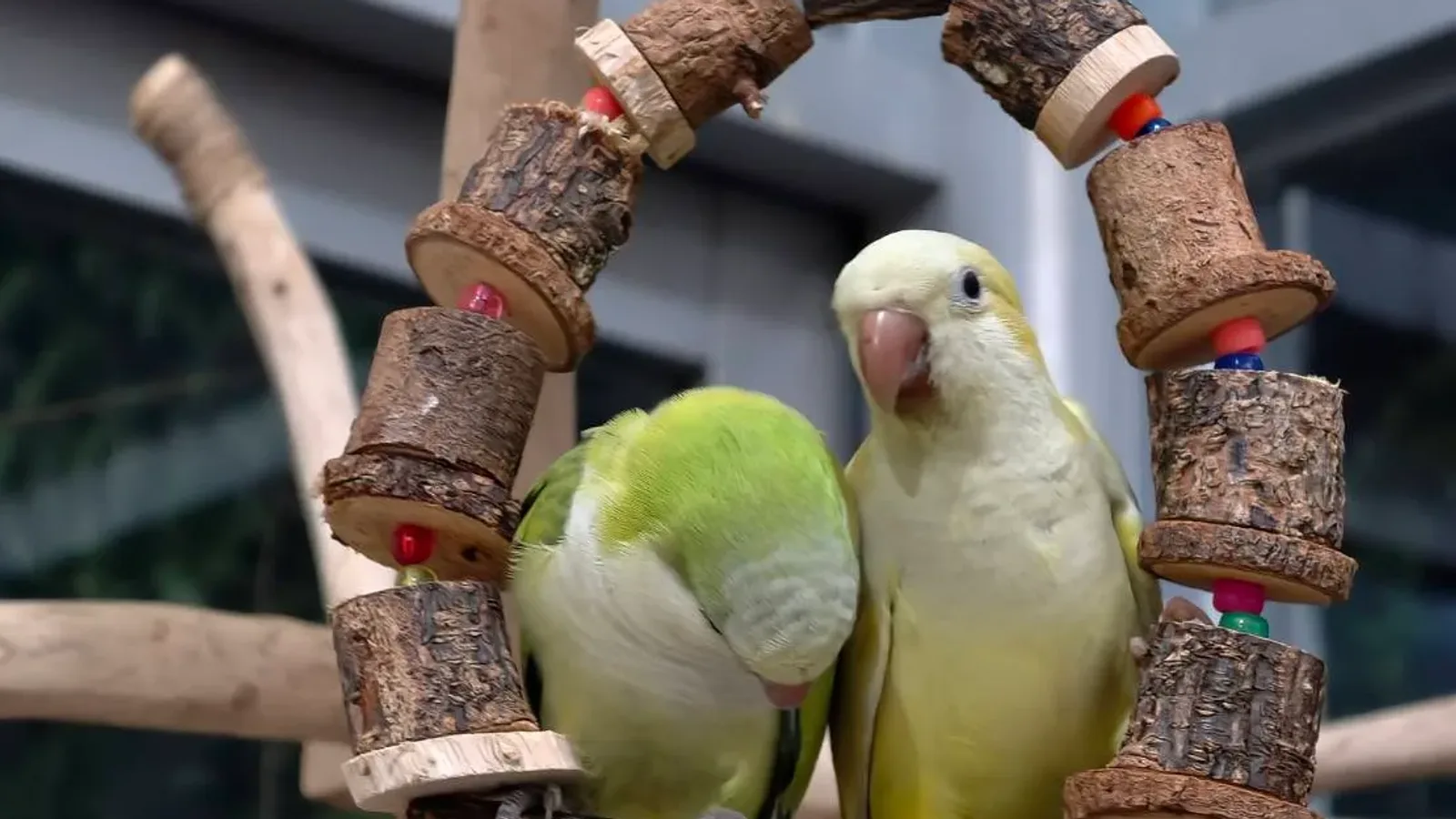
As for whether to keep 1 bird or 2 in a condo, my answer is 1 to begin with. Two monk parakeets chatter to each other and compete to be heard, and the combined noise is much louder than you would expect. A paired bird also bonds less to people. If you want a second bird, decide after the first has settled in and the neighbours have had no issues for about 6 months.
Living alongside neighbours and building management
One principle covers every situation: never let your neighbours discover you have a bird by hearing it first. Let them hear it from you. I have kept Quaker parrots in a condo without a single complaint, because I have done this from day one.
What I do and recommend:
- Read the building rules before buying the bird. Many condos say no pets, but in practice that usually means dogs and cats. Some state outright that caged birds are allowed. Ask the management office directly whether a small caged parrot is acceptable, so there are no surprises later.
- Introduce yourself to the units on both sides. Tell them you have a small bird, that there may be some noise in the morning and evening, and that they should come straight to you if it bothers them. That one sentence works wonders. People are far more irritated by noise of unknown origin than by noise whose owner clearly cares.
- Set your own quiet hours. I do not let the bird out to play after 9 at night, and the cage is covered before 10 every night. Night noise is what people tolerate least.
- Beware of echo from the balcony. A condo balcony is a concrete box that amplifies sound remarkably well. If you take the bird out for some sun, do it mid morning after people have left for work, and keep it under 30 minutes. Beyond the noise, there is the heat and the risk of escape to think about.
- Have an answer ready if someone complains. If a neighbour says the noise is bothering them, do not argue. Apologise and ask which time of day is worst. It is usually one specific window, and you can fix that, whether by moving the cage to another corner or uncovering it later.
One thing people overlook is the repair technician or the cleaner coming into the unit. Monk parakeets are startled by strangers and can let out a long screech. If you know in advance someone is coming, move the bird to the bedroom and shut the door, or cover the cage temporarily.
A daily routine for condo monk parakeet owners
A consistent routine is the best noise reducer there is, because the bird learns that you always come back and it does not need to call for you. This is my actual weekday schedule. Adjust the times to fit your own.
| Time | What to do | Why |
|---|---|---|
| 07:00 to 07:30 | Uncover the cage, change the water, give pellets, talk to the bird for 5 to 10 minutes | The bird sees you as soon as it wakes, which cuts morning calling |
| 07:30 to 08:00 | Let it out while you get ready | Burns off energy before a long day in the cage |
| 08:00 to 18:00 | In the cage with the radio on low, chew toys and foraging toys available | Keeps it occupied and stops the room feeling silent |
| 18:00 to 20:30 | Out of the cage, eat together, practise step up and words, change the cage liner | The main quality time of the day |
| 20:30 to 21:30 | Back in the cage, small pieces of fruit and veg, clear leftovers before bed | No fresh food left overnight to smell |
| 21:30 to 22:00 | Cover the cage, lights off | The bird gets 10 to 12 hours of sleep. A well rested bird is calmer and quieter |
On weekends I let the bird out for longer, but I keep the night time cover schedule exactly the same. A monk parakeet short on sleep becomes irritable, bites and calls noticeably more often.

Who should not keep a monk parakeet in a condo
You should not keep one if you are regularly away from the unit for more than 12 hours a day, if you travel often with nobody to care for the bird, or if your condo walls are so thin you can clearly hear the neighbour's television. I say this bluntly because I have seen too many cases where the bird had to be rehomed within the first year, which is bad for everyone involved.
If that describes you but you still want a parrot, consider a cockatiel or a lovebird. They are quieter and cope slightly better with time alone. Or wait until your circumstances change and come back to the Quaker parrot later. These birds live 20 to 30 years. There is no rush.
But if you spend most of your time at home, work remotely or have family members around all day, the monk parakeet is in my view one of the most rewarding parrots you can keep in a condo. It is intelligent, it talks, it bonds deeply, and it is easy to care for once you set up a good system from the start. Be honest with yourself about time and honest with your neighbours about noise, and you and your bird will get along for many years to come.
Frequently asked questions
How many hours a day should a monk parakeet be out of the cage?
At least 2 hours a day, and 3 to 4 hours is ideal. A bird that gets enough play time and closeness to people calls out noticeably less.
Can I leave my monk parakeet alone in the unit if I travel for 2 to 3 days?
Do not leave it alone for more than 1 day. The water can foul and the bird will get stressed and call all day, disturbing the neighbours. Arrange for someone to check in daily, or board it with a friend the bird already knows.
Does running the air conditioning all day affect a monk parakeet?
It is fine at 25 to 27 degrees Celsius, as long as the airflow does not blow directly onto the cage. Offer a shallow bathing dish 2 to 3 times a week, because air conditioned rooms are dry and the feathers become dry and itchy.
Will a monk parakeet chew the furniture in my condo?
Definitely, especially wooden edges, curtains and charging cables. Supervise it every moment it is out of the cage and keep every cable out of reach, because biting into a live wire can be fatal.
Do monk parakeets call at night?
Normally not, as long as the cage is covered and the room is dark. They may give a short screech if startled by a loud noise or a sudden light. A dim night light in the corner of the room helps reduce night frights.
Can a monk parakeet live with a cat or dog in a condo?
Yes, but always keep them in separate rooms whenever the bird is out of the cage. Cats in particular have a strong hunting instinct toward birds, and even when they seem used to each other you should never trust them 100 percent.
If my monk parakeet escapes from the balcony, will it come back?
Usually not. It flies high, gets disoriented and cannot find its way home. Never take the bird onto the balcony without a cage or a harness, and fit the balcony with mesh or bird netting as well.
Based on hands-on breeding and keeping experience, reviewed at every update · Published 8 Sept 2026