Can Monk Parakeets Talk? When They Start and How to Teach Them Step by Step
 Written by the NokMonk team, monk parakeet breeders in ThailandUpdated 12 Sept 2026Read time 11 min
Can monk parakeets talk, and at what age? A breeder explains how to teach a monk parakeet to talk, which words to start with, and the mistakes beginners make.
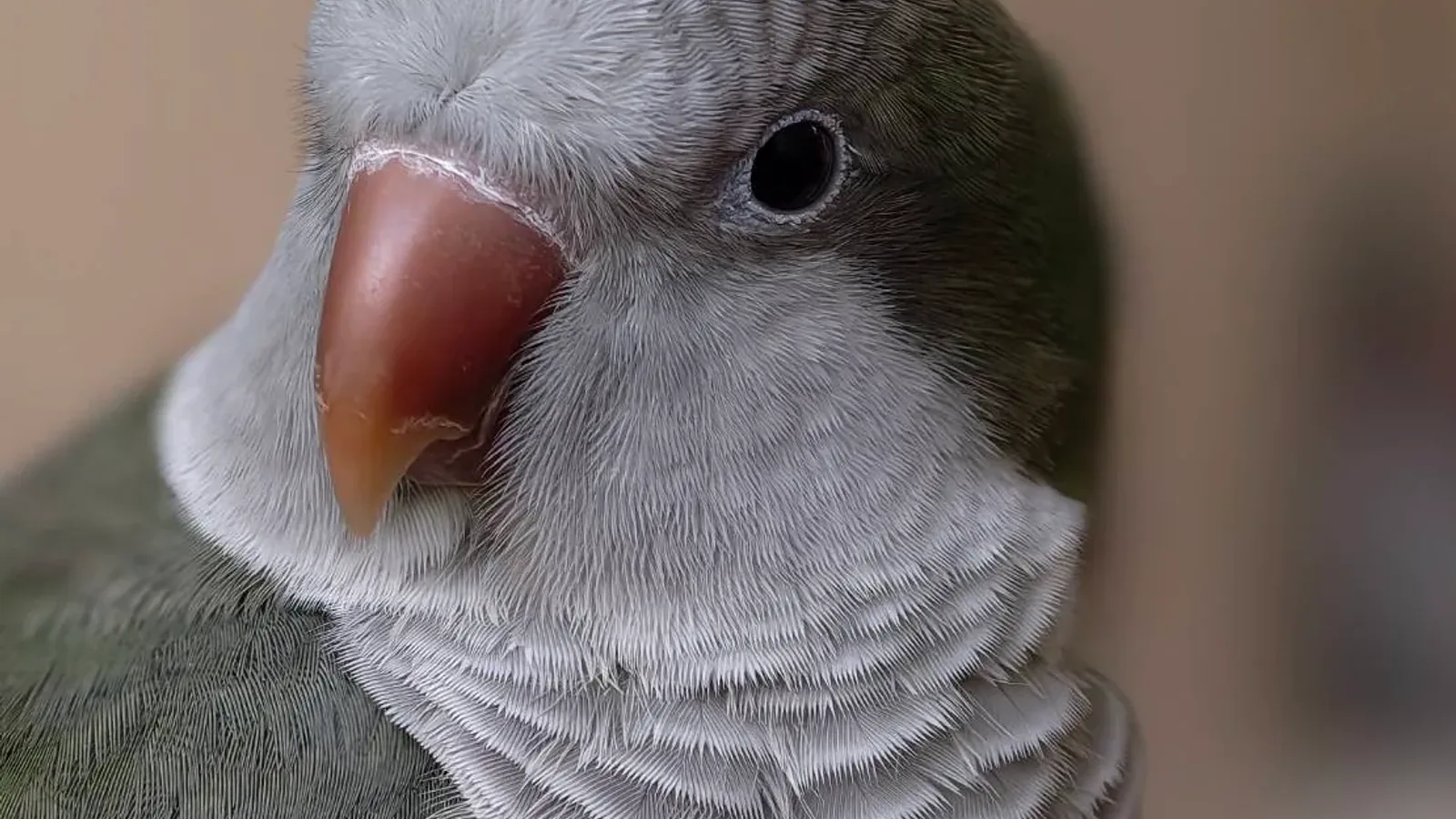
The question I get asked most when people come to see the babies at our home is not about food or cages. It is "Can monk parakeets talk?" followed almost immediately by "So when do they start?" In this article I will answer both from years of keeping and breeding these birds, and walk you through a training method that works at home with nothing more than your voice and a few sunflower seeds.
Can monk parakeets talk?
Yes, monk parakeets can talk, and among small parrots they are one of the clearest and most capable talkers you will find at this size and price. Raised the right way, most will manage at least 3 to 5 words, and the gifted ones string together short sentences and mix in a whole library of household sounds.
Overseas keepers know this bird as the Quaker parrot, and its reputation as a talker goes back decades. People who have kept several talking species tend to agree that a monk parakeet speaks noticeably more clearly than a lovebird or a cockatiel, and many individuals come close to large parrots that cost several times as much.
One thing I want every beginner to understand from day 1: "can talk" does not mean "every bird will talk." Each monk parakeet has its own personality. Some chatter so much it gets annoying, some prefer copying sounds to saying words, and some stay silent their whole lives while being wonderfully tame. Talking is a bonus of keeping this bird, not a guaranteed feature you buy off the shelf.
At what age do monk parakeets start talking?
Most monk parakeets say their first word somewhere between 3 and 6 months old, and their speech keeps getting clearer until they are about 1 year old. If you want a single number, I would say 4 months, because that is when the babies at our home most often produce their first recognisable word.
Before the first word comes a "mumbling" stage, where the bird makes soft, muffled noises in its throat, a bit like a person muttering under their breath. This usually starts at 2 to 3 months, not long after weaning. If you hear this kind of mumbling while the bird is resting or in the early evening, it is practising. This is the best sign that a first word is on the way.
Some birds are late starters. I once had one that stayed completely silent until 8 months and then came out with 3 words in a single week. So if your bird is 6 months old and still quiet, do not give up. As long as it is mumbling and paying attention to human voices, there is still a good chance. For a fully grown bird past 2 years that has never spoken, the odds drop a lot, but they are not zero.
Do male or female monk parakeets talk better?
In my experience, both male and female monk parakeets talk, and the difference between individual birds is far bigger than any difference between the sexes. If you want a strong talker, judge the bird's personality, not its sex.
This is unlike budgies, where males are clearly the better talkers. With monk parakeets I have had a hen that spoke more than 20 words, and a cock that never said a word but did a perfect impression of the doorbell. On top of that, you cannot sex a monk parakeet by eye. Only a DNA test will tell you. So anyone who says "this one is a male, he will definitely talk" without a test result is guessing.
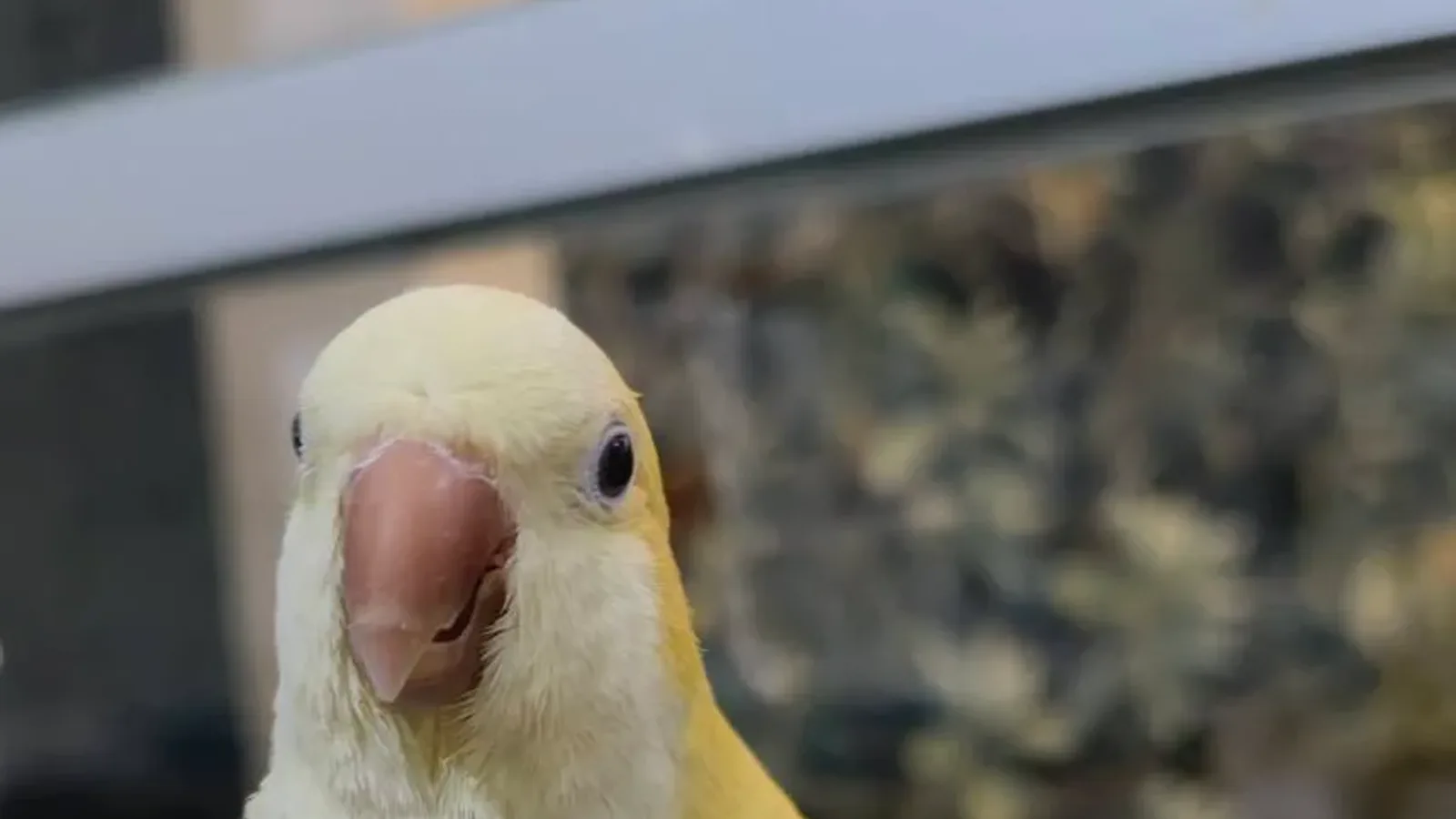
Colour has nothing to do with talking either. A hand-fed standard green at 5,000 to 9,000 THB talks just as well as a blue at 15,000 to 25,000 THB, or an Opaline or Lutino that can run 20,000 to 40,000 THB. These are Thai market prices, and the difference comes from colour and genetics, not talking ability. Prices also move with the season, how tame the bird is, and the bloodline of the parents.

Why some monk parakeets refuse to talk
The most common reason is that the bird has not bonded with people, not that it cannot talk. A monk parakeet imitates the sounds of its "flock." If you are its flock, it will try to speak human. If its flock is the bird in the next cage, it will squawk like a bird instead.
Other causes I see all the time:
- Kept with other birds A monk parakeet kept as a pair or in a group almost never talks, because it has no need to communicate with people.
- Bought as an adult that is not tame A bird that is afraid of people will not talk to people. You have to tame it first, which takes far longer than raising a hand-fed baby.
- A house that is noisy all day TV running constantly, several people talking at once. The bird cannot work out which sound it is supposed to copy.
- The owner rarely talks to the bird No model to imitate. However clever the bird is, there is nothing for it to say.
- Personality Some birds simply do not like talking, the same way some people are naturally quiet.
If your bird fits any of these, fix that first. Usually just moving the cage into the room where people spend the most time and talking to the bird every day shows a change within 1 to 2 months.
What to sort out before you start teaching
The one thing you must have before any speech training is a bird that is tame and trusts you. If it still fears hands or will not step up, work on that first. A frightened bird is in no mood to learn anything.
Next is where the cage sits. I recommend the room where the family spends the most time, such as the living room or next to your desk, but not the kitchen because of smoke and oil fumes. A monk parakeet that watches people walk past and hears conversation all day absorbs words on its own, even when you are not deliberately teaching.
Last is consistency between the people doing the teaching. If several people live in the house, agree on which word to teach first and say it with the same tone and rhythm. A monk parakeet memorises sound as a package: the word, the pitch and the timing together. If Dad says "hello" one way and the kids say it another, the bird gets confused and takes much longer.
How to teach a monk parakeet to talk, step by step
The whole method comes down to 3 principles: repeat, speak when the bird is paying attention, and reward the instant it tries. Everything else is about turning that into a daily routine and not stopping.
- Pick 1 word only Do not teach several words at once. Choose 1 short word, such as "hello," and stick to that single word until the bird can say it.
- Find the bird's alert times The best windows are the morning after breakfast and the late afternoon before dusk. Monk parakeets are at their chattiest in these 2 periods.
- Bring the bird close to your face Have it perch on your hand or shoulder, roughly an arm's length from your mouth, so it can watch your lips as you speak.
- Say the word slowly and clearly Use a bright, cheerful voice pitched slightly high. Repeat it 5 to 10 times per session, 3 to 5 sessions a day, and keep each session under 5 minutes. Any longer and the bird gets bored.
- Use the word in real situations If you are teaching "hello," say it every time you walk into the room and every time you take the cover off the cage. The bird links the word to the event, which is far faster than plain drilling.
- Reward every attempt At first the sound will be rough. You may only get "lo" or a mumble with the right rhythm. Praise immediately and hand over a tiny treat, such as 1 sunflower seed or a small piece of corn.
- Add a new word once the first is clear When the bird says the first word clearly and unprompted, start word number 2. Every word after the first comes much faster.
- Keep going every day Skip a week and the bird will not forget, but progress slows noticeably. Consistency matters more than how long each session runs.
As for leaving recordings or video clips playing while you are out, I have tried it and it helps a little, but not much. A Quaker parrot learns from the person it interacts with far more than from a sound coming out of a speaker. If you use recordings, treat them as a supplement, not the main method.

Which word should you teach a monk parakeet first?
The best first word is a short one of 1 to 2 syllables that you will naturally say to the bird every day anyway. I recommend "hello" or the bird's own name, because those are the words it hears most often without any effort on your part.
Words a monk parakeet picks up easily tend to have hard consonants like K, T, P and D, and clear vowel sounds. These come out naturally for a parrot. Words packed with R, L and S blends, or long multi-syllable words, will only come out in pieces. Save those for later once the bird is talking fluently.
| Suggested word | Difficulty | Daily chance to use it | Notes |
|---|---|---|---|
| Hello | Easy | Every morning when you uncover the cage | The most common first word among the birds at our home |
| The bird's name (keep it to 1 or 2 syllables) | Easy | Every time you call the bird | Avoid names with R blends, such as "Cream" |
| Dinner | Easy | At morning and evening feeding | Birds link words to food very quickly |
| Bye bye | Easy | When you leave the house | The B sound is easy. Birds often say it while bobbing |
| Bath time | Medium | When you mist the bird or put out the bath dish | Birds that love bathing learn this one fast |
| Love you | Medium | During head scratches or cuddles | The L often comes out soft or slurred, which is fine |
| Where you going | Medium | When you walk out of the room | Birds often say it when they see someone pass the cage |
| Good morning | Hard | Every morning | 3 to 4 syllables. Teach it after the bird can say "hello" |
The biggest thing to watch out for is swearing. A monk parakeet picks up words spoken with strong emotion faster than the words you are deliberately teaching. I have had customers come back and tell me the bird learned a swear word before "hello," because someone in the house cursed at the football. Once a word is learned it is very hard to get rid of, so mind your language from the day the bird arrives.
How long does it take to teach a monk parakeet to talk?
The first word takes roughly 2 weeks to 2 months if you start when the bird is 3 to 4 months old. After that, each new word usually takes only 1 to 3 weeks, because the bird has worked out that human speech is the thing to copy.
The table below shows the development pattern I see most often in the babies we raise. These are typical figures, not fixed rules. Individual birds can be a month or more ahead of or behind this.
| Age | What you usually see | What to do |
|---|---|---|
| 2 to 3 months | Weaned, starts mumbling in the throat, soft noises while resting | Tame the bird, practise step up, talk to it daily. No need to push words yet |
| 3 to 4 months | Mumbling more often, starting to take on the rhythm of human words | Begin serious first-word training, 3 to 5 sessions a day |
| 4 to 6 months | First word appears, still unclear, maybe only part of a syllable | Reward every attempt, keep repeating the same word until it is clear |
| 6 to 9 months | Clearer speech, starts talking unprompted, begins copying other household sounds | Add new words 1 at a time, start on words of 2 syllables or more |
| 9 to 12 months | Several words, some birds manage short phrases and use words to match the situation | Teach short phrases and longer words, keep the same routine |
| 1 year and up | A talker will keep talking for life and keep picking up new words | Talk to the bird every day and never let things go quiet for too long |
Something many people do not realise is that a monk parakeet learns every sound in the house, not just words. The microwave beep, phone notifications, coughing, laughing. I have one that does the sound of a water bottle cap being twisted open so accurately that people turn around to look. If your bird copies these sounds but has not said a word yet, the ability is clearly there. It just needs pointing in the right direction.
Mistakes beginners make when teaching a monk parakeet to talk
The most common mistake is impatience and switching words too often. The bird has not yet locked in the first word when the owner moves on to a new one. The result is a bird that hears a jumble of words and says none of them.
- Training when the bird is sleepy or eating It is not paying attention to you, so you both waste your time. Wait until it has finished eating and is fully alert.
- Shouting or speaking loudly at the bird It gets startled instead of listening. Use a normal volume, but keep it clear and rhythmic.
- Too many treats Sunflower seeds are very fatty. 1 seed per reward is enough. Overdo it and the bird gets overweight and sickly.
- Laughing when the bird screams A Quaker parrot learns which sounds get attention. If you react to screaming, it will scream more than it talks. Respond only when it is trying to talk or making soft sounds.
- Expecting it to perform for guests Monk parakeets tend to talk with the people they trust when the house is quiet. Around strangers, most go silent. That is normal.
- Buying a bird the seller says "already talks" without hearing it If a seller claims the bird talks, ask to hear it yourself, or ask for a video where you can clearly see the bird while it speaks.
One last thought. The monk parakeet is a highly intelligent bird that bonds deeply with people. Even if yours never says a single word, it will still greet you every morning in its own way. Keep it because you love it first, and if it talks, count that as a bonus. That way you will not be disappointed, and the bird will be happier too.
Frequently asked questions
Can an adult monk parakeet that has never talked still learn?
Yes, but it is much harder and slower than with a baby. You have to tame the bird and earn its trust first, then start the first word with the same method. Some take months to produce a first word, and some never talk but copy other sounds instead.
Do monk parakeets understand what they are saying?
Not the way a person does, but they do link words to events. A bird might say "dinner" when it sees you walking over with the food bowl, or "bye bye" when you pick up your keys. That comes from repetition in the same situation.
How many words can a monk parakeet learn?
A typical bird learns 5 to 15 words. A very gifted one can learn dozens and speak short phrases. This depends on the bird's personality and how much time you put in, far more than on colour or bloodline.
Does a monk parakeet have to be kept alone to talk?
In practice, yes. A bird kept on its own with people talks far better than one kept as a pair. If you have several birds and want them to talk, house them in separate cages placed well apart and give each bird its own time with you.
Are talking monk parakeets loud? Will they bother the neighbours?
Their speaking voice is not loud, but the scream when they are startled or want attention carries quite a bit. If you live in a condo or a terraced house, be prepared for this, and train the bird from a young age not to scream to call you.
What sounds can a monk parakeet copy besides words?
Almost anything it hears repeatedly around the house: phone notifications, the microwave, laughter, coughing, kissing sounds, a dog barking, and doors opening and closing.
Should I leave a training recording playing while I am out?
You can, but do not expect much. A monk parakeet learns far better from a person who interacts with it than from a speaker. If you use recordings, treat them as a supplement, keep the volume down, and do not run them all day or the bird will get stressed.
Based on hands-on breeding and keeping experience, reviewed at every update · Published 8 Sept 2026