Monk Parakeet Colours Explained: Green, Blue, Opaline, Lutino and What Split Really Means
 Written by the NokMonk team, monk parakeet breeders in ThailandUpdated 12 Sept 2026Read time 12 min
Every monk parakeet colour sold in Thailand: green, blue, Opaline, lutino, Turquoise, Pallid, Cinnamon. What split means, what cross means, and current prices.
After "are they hard to keep", the question I hear most from first-time buyers is "what colours do monk parakeets come in". Then, the moment they start comparing prices, the words split and cross show up, and that is exactly where new buyers get confused and quietly overcharged. I have been breeding monk parakeets for many years, and I wrote this so that you can finish reading and walk up to any seller with confidence.
Which monk parakeet colours are available in Thailand right now
The Thai market currently has 7 main colour groups: green, blue, Opaline, lutino, Turquoise, Pallid and Cinnamon. On top of those there are combination colours, where 2 or more mutations sit in the same bird, such as Blue Opaline or Albino, and there are quite a few of these.
Green is the original wild colour of the monk parakeet. Every other colour is a mutation that breeders have preserved and built into lines. The colours do not just look different. They are inherited differently too, and the mode of inheritance decides which pairing gives you which chicks.
| Colour | What you see | Inheritance | Notes |
|---|---|---|---|
| Green | Bright green body, grey scalloped face and chest, deep blue flight feathers | Wild type, dominant | Cheapest and hardiest |
| Blue | Sky blue body, greyish white face and chest, no yellow at all | Simple recessive | Both males and females can be split |
| Opaline | Chest barring fades, body brightens, pale V shaped patch on the back | Sex-linked recessive | Females cannot be split |
| Lutino | Whole body yellow, red eyes, white flight feathers | Sex-linked recessive | Combined with blue gives Albino, white with red eyes |
| Turquoise | Blue green, with yellow still showing on wings and belly | Recessive, same locus as blue | Pair with blue and you get Turquoise straight away |
| Pallid | Whole body diluted to pastel, faint chest barring | Sex-linked recessive | Same locus as lutino |
| Cinnamon | Dark pigment turns brown, green body looks soft yellowish green | Sex-linked recessive | Chicks hatch with red eyes that darken later |
You will notice sex-linked appears in several rows. That term matters a great deal, because it decides whether a female can carry a colour as a split or not. I explain it fully in the split section further down.
Green versus blue monk parakeets, what is the actual difference
A blue monk parakeet is simply a bird in which the blue gene removes all yellow pigment from the feathers. Green becomes blue, and the pale yellow on the belly becomes white. Beyond colour, temperament, body size, diet and talking ability are identical to a green.
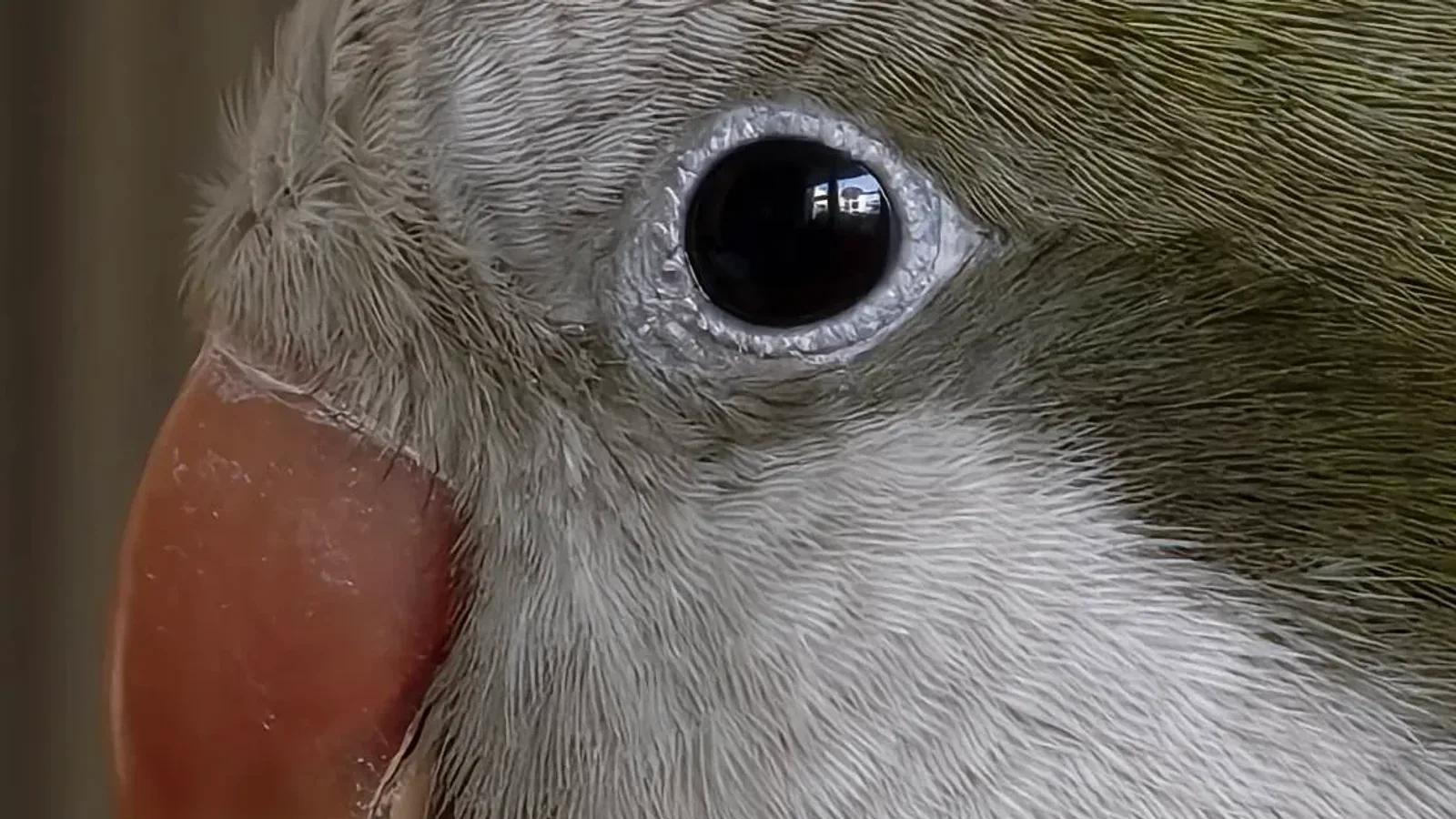
Look closely and you will see the face and chest of a blue still carry the same grey scalloping as a green, but the background is greyish white rather than greyish green. The flight feathers are a deeper blue than the body, and the blue deepens slightly once the bird matures compared to how it looked as a hand-fed chick.
What every beginner should know is that blue is a simple recessive gene. A bird only shows blue if it receives the gene from both parents. Get it from one parent only and the bird comes out green but carries blue hidden inside. That is where the "green/blue" bird comes from, and why it costs nearly twice as much as an ordinary green.
On hardiness, in all my years I have never seen blues turn out meaningfully weaker than greens. Blue chicks from lines that have been sibling-bred for several generations can be smaller or have poorer feather, but that is a bloodline issue, not a colour issue.
What an Opaline monk parakeet looks like and why it costs so much
An Opaline monk parakeet carries a gene that redistributes the dark pigment across the body. The grey barring on the chest fades almost to nothing, the whole bird looks brighter, and the back shows a pale area framed by darker feathers in a V shape. It is expensive because it is a sex-linked gene that is hard to produce, and not many breeders in Thailand have it yet.
Opaline on a green bird gives a bright yellowish green, a clearly yellow face and a soft yellow chest instead of the grey scalloping. Some lines show a faint orange wash on the back feathers, and that is the detail Opaline fans hunt for.
Blue Opaline is a bird carrying both the blue gene and the Opaline gene. It comes out a soft pastel blue with a clean white face and chest and no grey barring at all. This is the most expensive bird in the Opaline group, because it combines 2 separate genetic systems and normally takes at least 2 generations to produce.
At 3 to 4 weeks old, Opaline chicks are hard to pick out if you are not experienced, because the feathers have not fully come in. My advice is to focus on the chest. If there is no grey scalloping from the very first feathers, the odds of Opaline are high.

How to tell lutino, Turquoise, Pallid and Cinnamon apart
These 4 colours each have one key giveaway. Lutino is yellow with red eyes, Turquoise is blue with green in it, Pallid is washed out all over in a pastel way, and Cinnamon turns the dark pigment brown. Let me go through them one by one.
Lutino
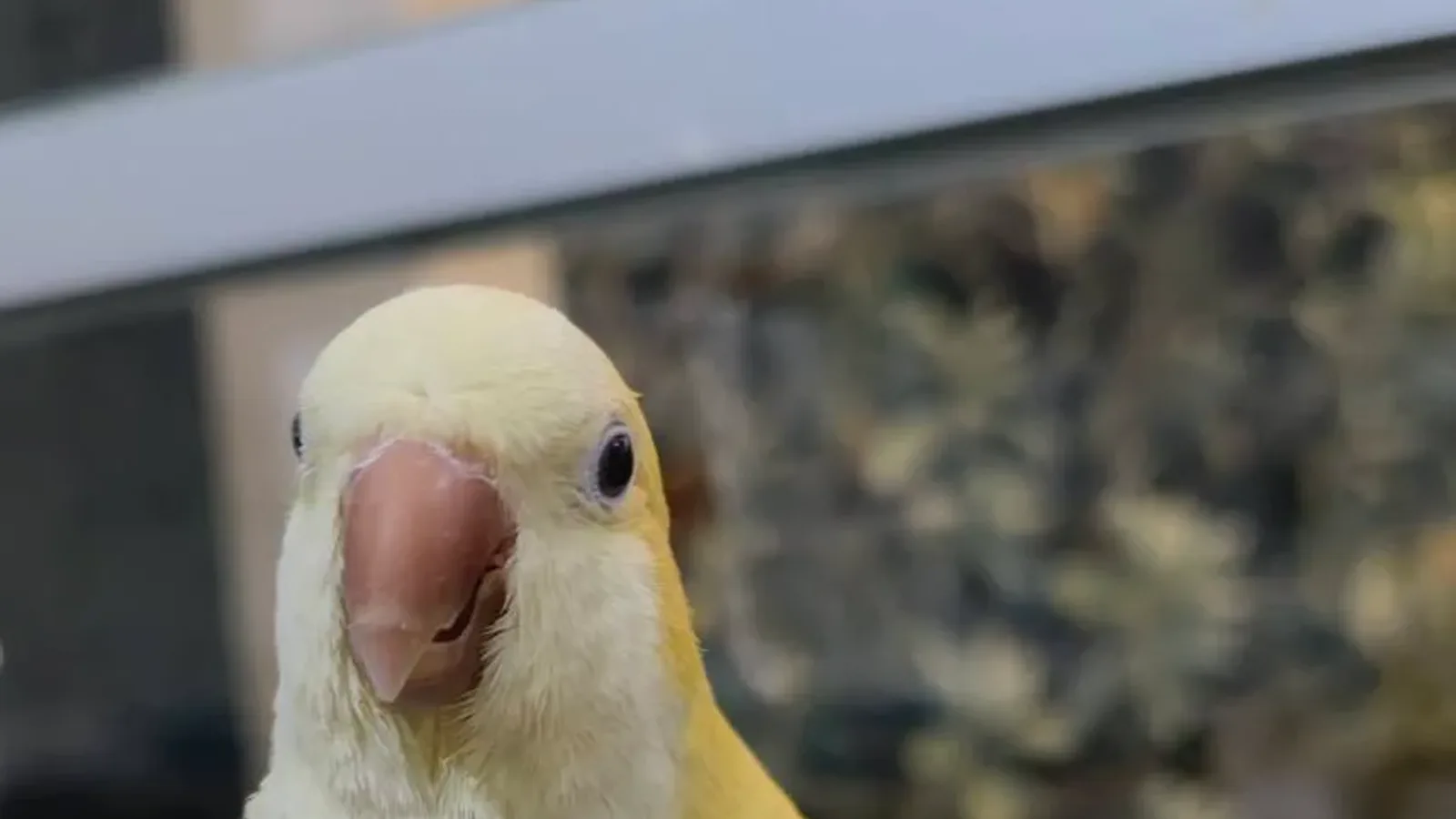
A lutino is a bird in which the gene strips out all dark pigment, leaving pure yellow. The eyes are clearly red from hatching to adulthood, and the flight feathers and tail are white. It is a stunning bird in an aviary, but the red eyes make it more sensitive to bright light than usual, so always give it a shaded corner in the cage.
Combine lutino with blue in one bird and you get an Albino, pure white with red eyes. In Thailand this combination is commonly called a "white monk".
Turquoise
Turquoise sits at the same gene locus as blue, but it does not remove all the yellow. The bird comes out blue green with yellow still showing on the wings and belly. If a bird gets one Turquoise gene and one blue gene, it shows a Turquoise tone that leans slightly bluer. This is why Turquoise is easier to breed than the other colours if you already have blues.
Pallid
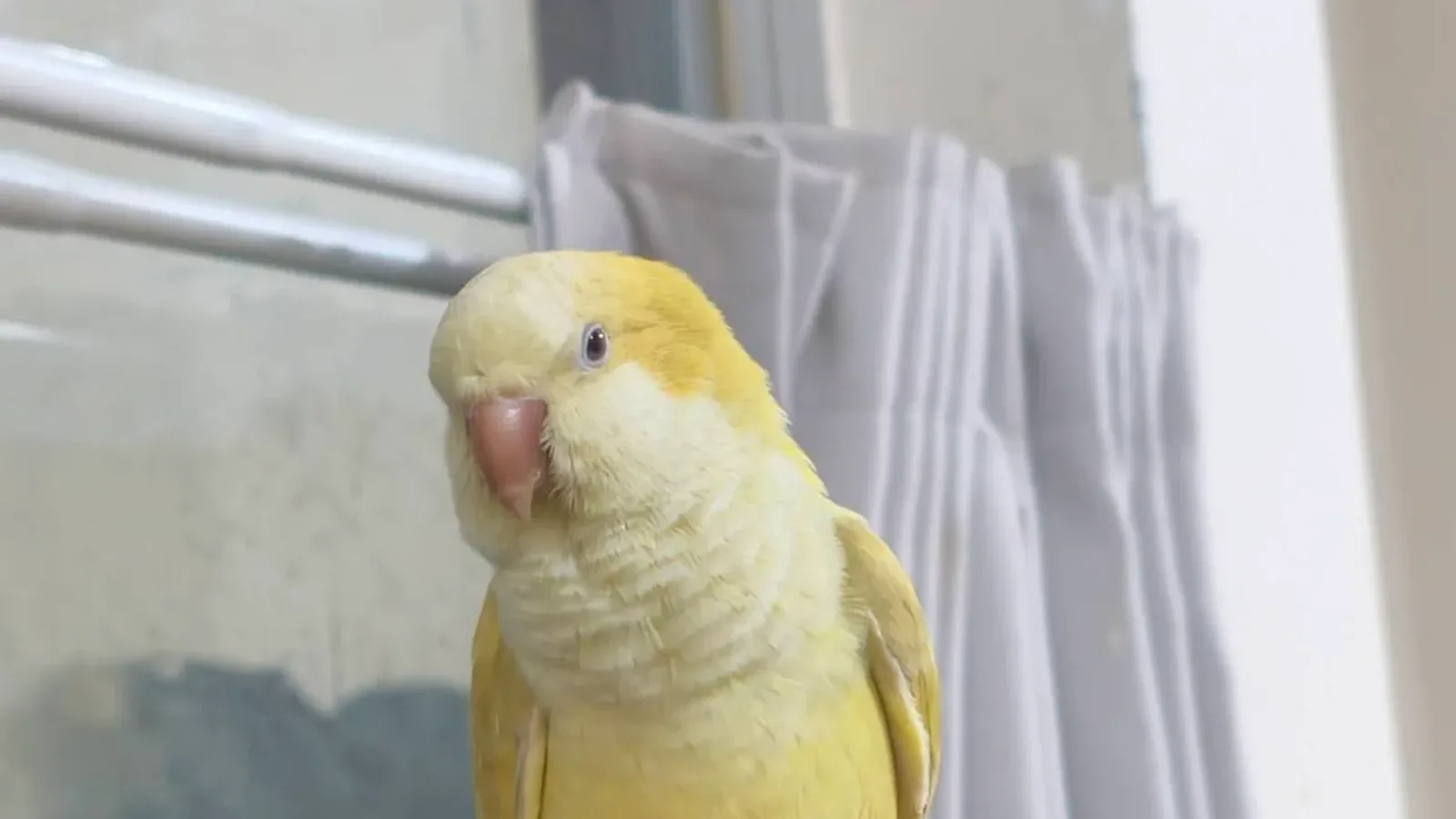
Pallid is a relative of lutino at the same locus, but it removes only part of the dark pigment. The bird comes out a light yellowish green with faint chest barring. The eyes are red at hatching and gradually darken until they look almost black. Blue Pallid is a soft pale blue that many people consider prettier than a standard blue.
Cinnamon
Cinnamon changes the dark pigment from grey black to brown. A green bird becomes a soft yellowish green with flight feathers in greyish brown instead of blue. Blue Cinnamon is a pale blue with brown wings. Chicks hatch with deep red eyes that turn dark within 1 to 2 weeks, and that is how I separate Cinnamon from ordinary green from day one.
Note that lutino, Pallid, Cinnamon and Opaline are all sex-linked genes. So the split rules for these 4 colours are identical, and they differ from blue and Turquoise, which are simple recessives.
What split means and whether you can see it
A split is a bird that carries one copy of a colour gene hidden inside without showing it. On the outside it looks exactly like an ordinary green in every way. You cannot see it. The only way to know is from the parents or from the chicks the bird produces.
Breeders write it with a slash, for example "green/blue", read as green split blue. It means the bird is green but carries one copy of the blue gene. Paired with a blue, or with another green/blue, it has a chance of producing blue chicks. That is why a split sells for more than an ordinary green even though the two look identical.
For simple recessive genes like blue and Turquoise, both males and females can be split. For sex-linked genes like Opaline, lutino, Pallid and Cinnamon there is a special rule: only males can be split. A female carrying any of these genes shows the colour outright. There is no such thing as a female split Opaline.
The reason is that male birds have ZZ sex chromosomes and females have ZW. Sex-linked genes sit on the Z chromosome. A male has 2 Z chromosomes, so one copy of the gene can stay hidden. A female has only 1 Z, so any gene she receives is expressed immediately. If someone offers you a "female split Opaline", the seller either does not understand the genetics or is deliberately misleading you.
You will also meet two more terms in the market: "definite split" and "possible split". A definite split comes from a pair where one parent is a full visual of that colour, so every green chick is guaranteed to carry the gene. A possible split comes from two green/blue parents, and the green chicks may or may not carry the gene. You cannot tell, so the price should be lower than a definite split.
What a cross monk parakeet is and how it differs from split
Cross is the word the Thai market uses for a bird whose parents were two different colours. Green cross blue means a chick from a green paired with a blue. Split, on the other hand, is a genetic term stating exactly what gene the bird carries. Cross is the broader word, and it does not always guarantee that the bird carries anything.
The problem is that everyone uses cross differently. Some mean a green/blue that is a definite split. Some mean a possible split. Some use it for combination birds like "blue cross Opaline", which should properly be called Blue Opaline. Whenever you hear the word, always ask the seller these 2 questions.
- What colour is the father, and what colour is the mother? If they cannot answer, value the bird as an ordinary green.
- Is it a definite split or a possible split? Only if one parent is a full visual blue can it be called definite.
Another way people use cross is to mean a bird that combines 2 mutations in one body, which breeders call a combination, such as Blue Opaline, Turquoise Cinnamon or Blue Pallid. These birds really are expensive and really are hard to produce, but the colour has to be clearly visible. A green bird described as a "3 colour cross" with nothing to back it up is not a combination.
Here is the short version to remember. Split tells you what gene the bird carries. Cross only tells you the parents were different colours. If you are going to pay a premium, pay for the word split with named parents, not for the word cross on its own.

Which pairings give which colours
The short answer: blue with blue gives all blue, green with blue gives all green/blue, and green/blue with blue gives roughly half blue. For sex-linked genes it depends on which parent is the male. This is the table I use at my own home, so feel free to work from it directly.
| Father x Mother | Expected chicks (average) |
|---|---|
| Green x Blue | Green/blue 100% |
| Green/blue x Blue | Blue 50%, green/blue 50% |
| Green/blue x Green/blue | Blue 25%, green/blue 50%, ordinary green 25% (the 2 kinds of green look identical) |
| Blue x Blue | Blue 100% |
| Blue x Turquoise | Blue toned Turquoise 100% |
| Opaline male x Green female | All daughters Opaline, all sons green/Opaline |
| Green male x Opaline female | All sons green/Opaline, all daughters ordinary green |
| Green/Opaline male x Opaline female | Sons: Opaline 50%, split 50%. Daughters: Opaline 50%, green 50% |
| Green/Opaline male x Green female | Sons: split 50%, green 50%. Daughters: Opaline 50%, green 50% |
The figures are theoretical averages. In real life a monk parakeet clutch is 4 to 7 eggs, and a single clutch can give you 3 blues or none at all. You need several clutches before the ratios in the table show up.
My favourite row is Opaline male x green female, because every daughter is Opaline without waiting 2 generations. Anyone with 1 good Opaline male can start a line right away. The rules for lutino, Pallid and Cinnamon follow the same table as Opaline, just swap the colour name.
One thing to watch: Turquoise and blue share the same locus, so pairing them gives Turquoise immediately as the table shows. But Turquoise with an ordinary green gives only green/Turquoise across the board, not a single visual Turquoise.
Current monk parakeet prices by colour in Thailand
Hand-fed monk parakeet chicks currently start at 5,000 to 9,000 THB for an ordinary green and go up to 20,000 to 40,000 THB for combinations like Blue Opaline. These are Thai market prices, and the ranges are wide because prices move with the season, how tame the bird is, and the genetics of the parents.
| Colour / status | Approximate hand-fed chick price (THB) | Notes |
|---|---|---|
| Ordinary green | 5,000 to 9,000 | Ideal for a first bird |
| Green split (green/blue, green/Opaline) | 10,000 to 16,000 | Parents must be identifiable |
| Blue | 15,000 to 25,000 | Best seller after green |
| Opaline, Turquoise, lutino | 20,000 to 40,000 | Opaline females usually cost slightly more than males |
| Combinations (Blue Opaline, Albino, Blue Pallid) | 20,000 to 40,000 and up | Depends on how rare the line is at the time |
Prices soften during peak breeding season, from the end of the cool season into early hot season, when plenty of chicks are available. Towards the end of the year, when chicks are scarce, prices easily climb by 1,000 to 3,000 THB. A hand-fed bird that is very tame, steps up on command and sits happily on your hand costs more than one that has just weaned and is not yet used to people.
Be wary of prices that look wrong in either direction. A blue at 8,000 THB usually has something hidden, such as illness, an older bird, or not a true blue at all. A green sold as a "3 colour cross" at 20,000 THB with no known parents is paying for words and nothing else.
Which colour to choose for your first bird
If you want a first companion, I recommend an ordinary green or a green split. The price is reachable, the bird is hardy, and it is every bit as charming as the expensive colours. If you plan to breed later, start with 1 blue male and 1 green/blue female, and you will have blue chicks to get excited about from the very first clutch.
Colour does not make a bird smarter or a better talker. A 6,000 THB green Quaker parrot that was hand-fed well and played with every day will talk more and be tamer than a 35,000 THB Blue Opaline left alone in a cage. I have seen this so many times that I can say it without hesitation.
When choosing a chick, look past the colour and check for clear eyes with no discharge, dry nostrils, even feather growth, normal nails and beak, and a bird that perks up when someone approaches. If the chick is listless, eating little or breathing heavily, do not buy it however pretty the colour.
Finally, whether you call it a monk parakeet or a Quaker parrot, this same bird will live with you for 20 to 30 years. The colour you choose today will be in your home longer than your car. Pick the bird that is healthy and that you genuinely love, and do not rush after whatever colour happens to be trending.
Frequently asked questions
What produces an Albino or white monk parakeet?
An Albino carries both the blue gene and the lutino gene in one bird. Blue removes the yellow, lutino removes the dark pigment, leaving pure white with red eyes. Both parents must carry genes from both systems for it to be bred.
At what age can you tell a chick's colour?
Lutino, Cinnamon and Pallid can be identified from eye colour on day one because they hatch with red eyes. Blue and green can be separated when the feathers start breaking through at 2 to 3 weeks. For Opaline, wait until the chest feathers are fully in at around 4 to 5 weeks.
Are expensive colour monk parakeets weaker than greens?
The colour itself does not weaken the bird. But rare colours are often bred from a small pool of birds that are paired repeatedly within close bloodlines, so you see small or poorly feathered birds more often. Choose from a line with strong parents and they are as easy to keep as any green.
Can a female be split blue?
Yes, because blue is a simple recessive gene and not sex-linked. Green/blue females do exist and breed well. The colours a female cannot be split for are only Opaline, lutino, Pallid and Cinnamon.
How do Pallid and Cinnamon differ? They look very similar.
Cinnamon turns the dark pigment clearly brown, most visibly in the flight feathers. Pallid dilutes the whole bird to pastel but the wings do not turn brown. The easiest check is to open the wing. If the flight feathers are brown, it is Cinnamon.
What are Cobalt and Dark Green in monk parakeets?
They come from the dark factor gene, which deepens the base colour. A green with 1 dark factor is Dark Green and with 2 is Olive. A blue with 1 is Cobalt and with 2 is Mauve. This gene is incompletely dominant, so a single copy already shows.
Does a monk parakeet's colour change as it matures?
The base colour does not change, but it becomes deeper and richer after the first moult at 6 to 12 months. A blue chick that looks washed out often turns much prettier by 1 year old. The eyes of Cinnamon and Pallid chicks change from red to dark within the first few weeks.
Can I breed siblings together to get the colour I want?
Genetically it works, but I do not recommend it. The closer the relation, the higher the risk of small chicks, poor feathering or eggs that fail to hatch. If you must, do it for 1 generation only and bring in fresh blood from another line straight after.
Based on hands-on breeding and keeping experience, reviewed at every update · Published 8 Sept 2026