How to Raise a Monk Parakeet: A Beginner's Guide from Day 1 to Adulthood
 Written by the NokMonk team, monk parakeet breeders in ThailandUpdated 12 Sept 2026Read time 11 min
Beginner's guide to raising a monk parakeet: choosing a chick, hand feeding, cage setup, taming, and spotting illness, with real price and feeding tables.
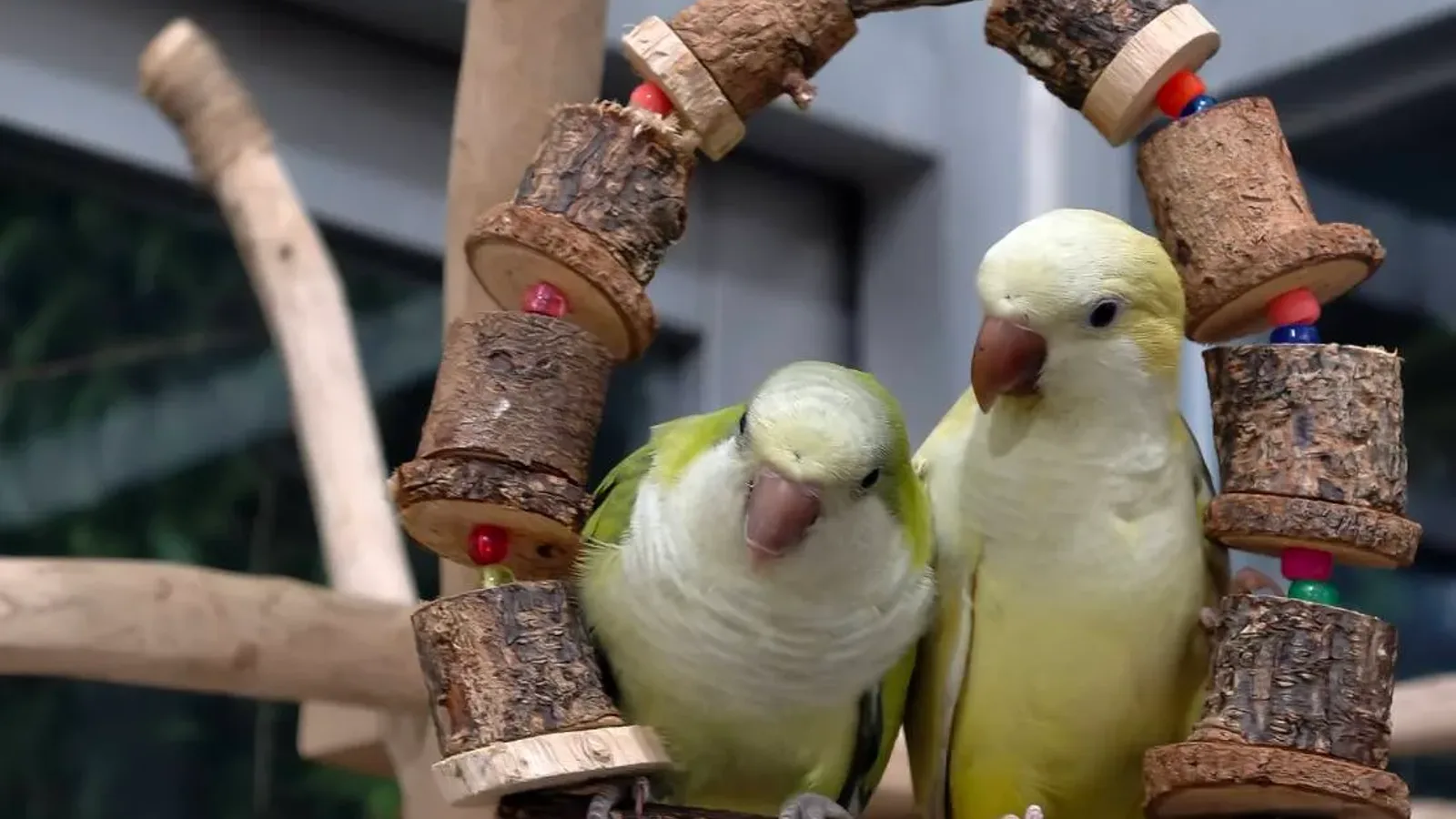
The monk parakeet, also known as the Quaker parrot, is a medium sized parrot that more and more people across Thailand and the region are choosing to keep. They are intelligent, deeply attached to their people, and speak more clearly than most parrots their size. I have kept and bred these birds for many years. I have seen chicks grow into clever, affectionate companions, and I have seen chicks that did not make it because their owners were not ready. This article is written so that a first time owner can finish reading it and actually keep their bird alive and well, not just keep it.
Are monk parakeets hard to keep? Can a beginner manage?
They are not hard, provided you can give the bird time every day and are willing to learn the basics before you bring one home. They become hard the moment you assume that buying a bird, putting it in a cage and filling a food bowl is the end of the job. Monk parakeets need interaction, and they have very strong personalities.
The upside of keeping a Quaker parrot is that adult birds are fairly hardy, easy to feed, cope well with tropical heat and humidity, and can live 20 to 30 years with proper care. The things you need to accept going in are the noise, the possessiveness over toys and cage, and the fact that a bird left alone for long stretches may start plucking its own feathers.
So the honest answer to "are monk parakeets hard to keep" is this: the hard part is the hand feeding stage and the first 2 to 3 months of settling in. Get past that and the bird becomes much easier. If you are not confident about hand feeding, I recommend starting with a weaned bird. It is the safer choice.
What age should you start with?
For a genuine beginner, the ideal age is 6 to 8 weeks. At that stage the chick is starting to eat some food on its own, needs only 1 to 2 hand feeds a day, still tames easily, and carries far less risk than a chick that has only just opened its eyes. A weaned bird of 3 months or older can still be tamed as long as it was hand raised from the start.
Chicks of 3 to 4 weeks that are not yet fully feathered are not something I recommend for anyone who has never hand fed a bird. They need temperature control, 4 to 5 feeds a day, and a single mistake can cost you the bird. The slightly lower price is not worth the risk.
Before you take a bird, check that the eyes are clear, the crop empties between feeds, the vent is clean with no droppings stuck to it, and the bird responds when you reach towards it. If the chick is listless, has its eyes closed, or is breathing so hard that its tail bobs, walk away no matter how cheap it is.
How much does a monk parakeet cost and which one should you buy?
A standard green hand fed chick currently costs 5,000 to 9,000 THB. Other colours go up from there depending on how rare the genetics are. For beginners I recommend starting with a plain green bird. Their behaviour and intelligence are no different from the expensive colours.
| Colour / genetics | Approximate chick price (THB) | Notes |
|---|---|---|
| Standard green | 5,000 to 9,000 | Best choice for beginners |
| Green split (carrying a hidden colour gene) | 10,000 to 16,000 | Looks like a standard green but useful for colour breeding |
| Blue | 15,000 to 25,000 | The most popular colour in Thailand |
| Opaline / Turquoise / Lutino and combinations | 20,000 to 40,000 | Prices vary widely with colour quality and bloodline |
The figures in the table are current Thai market prices and they move all the time. The main factors are season (chicks are plentiful from early rainy season to the end of the year, so prices soften), how tame the bird is, and the genetics of the parents. The same bird, if it is already tame and trained to step up, can fetch 1,000 to 3,000 THB more than an untamed one.
The word split means a bird that looks green but carries a hidden gene for another colour, for example green split blue. If you want a companion rather than a breeding bird, there is no reason at all to pay extra for a split.

What to do on the first day your bird comes home
On day 1, do only 3 things: set up a warm, quiet place for the bird, feed it at the same times the breeder did, and let it rest. Do not take it around to show relatives, do not bathe it, and do not switch its food straight away. The stress of moving home is one of the top reasons chicks fall ill in the first week.
Ask the breeder for the full details: which brand of formula, how thick it is mixed, how many feeds a day and at what times. Follow that exactly for at least 1 week before you change anything. If you want to change formula brands, blend the new one in gradually over 5 to 7 days.
In the first 2 to 3 days it is normal for a chick to eat slightly less. But if it refuses more than 1 feed entirely, or the crop has not emptied within 4 to 6 hours, contact the breeder or an avian vet immediately. Do not wait overnight to see how it goes.
How to hand feed a chick safely and how many feeds a day
There are only 3 rules that matter: formula must be warm at around 39 to 41 degrees Celsius, you feed only once the crop has emptied, and you cut the number of feeds as the bird gets older. Get these 3 right and almost every chick will make it.
| Age | Feeds per day | Approximate amount per feed | What else to do |
|---|---|---|---|
| 3 to 4 weeks | 4 to 5 feeds | 8 to 12 ml | Needs a brooder box kept at 30 to 32 degrees |
| 5 to 6 weeks | 3 feeds | 12 to 18 ml | Start offering pellets and vegetables to nibble |
| 7 to 8 weeks | 2 feeds (morning and evening) | 15 to 20 ml | Add a water cup and begin gentle step up training |
| 9 to 10 weeks | 1 feed (before bed) | As much as the bird will take | Weigh daily and drop the feed only if weight holds |
| 10 to 12 weeks | Weaned | Eating fully on its own | Keep weighing for another 2 weeks |
The amounts in the table are estimates. Always go by the crop. Feed until the crop is comfortably full like a soft balloon, not stretched hard. Formula that is too cold will be refused and digests slowly. Formula above 42 degrees can burn the crop. I check with a thermometer every single time, even after feeding thousands of chicks.
Place the syringe into the left side of the chick's beak, which is your right, because the bird's oesophagus runs down the right side of its body. Feed slowly, following the rhythm as the chick pumps. If it stops, you stop. Never push more in, because that risks aspiration into the lungs.
During weaning, a chick will lose about 10 percent of its peak weight. That is normal. If the weight keeps dropping or goes beyond that, go back to an evening top up feed. Do not rush weaning to match a textbook if the bird is not ready. Individual birds can differ by 2 to 3 weeks.
Cage and equipment every beginner needs
A realistic minimum cage for a single monk parakeet is at least 45 cm wide and deep, at least 60 cm tall, with bar spacing no wider than 1.5 cm. If budget and space allow, move up to 60 x 60 x 90 cm so the bird has room to play and stretch its wings fully.
| Cage size (W x D x H) | Suitable for | A breeder's view |
|---|---|---|
| 35 x 35 x 50 cm | Temporary holding or travel cage | Not for permanent use. The bird will stress and pluck |
| 45 x 45 x 60 cm | 1 bird that comes out to play daily | The bare minimum I would accept |
| 60 x 60 x 90 cm | 1 bird, or a compatible pair | The size I recommend most |
| 80 x 60 x 120 cm and up | Breeding pairs or owners who rarely let the bird out | Bigger is better, but check the bars are strong enough |
Choose a powder coated steel or stainless steel cage. Avoid cheap galvanised cages, because monk parakeets love to chew the bars and zinc builds up in the body as a toxin. The cage should have a pull out tray you can wash every day.
Other things you need from day 1:
- At least 2 natural wood perches of different thicknesses so the bird can shift its footing
- 1 to 2 stainless steel food cups and water cups each
- 2 to 3 chew toys such as soft wood, cardboard and cotton rope, rotated weekly
- A digital kitchen scale accurate to 1 gram. It costs under 300 THB and will save more birds than anything else on this list
- A cage cover for night time
Put the cage in a room where people spend time, out of direct sun, away from the kitchen and out of draughts. Fumes from an overheated Teflon pan are lethal to every kind of bird.

What monk parakeets can eat and what they must never eat
A weaned monk parakeet's diet should be roughly 60 to 70 percent formulated pellets, 20 to 30 percent fresh vegetables and fruit, and only a small amount of seed as a treat. Birds fed nothing but sunflower seed and millet tend to become overweight, develop fatty liver, and die younger than they should.
Vegetables you can offer daily include water spinach, kale, Chinese cabbage, carrot, steamed pumpkin, boiled corn and capsicum. Fruit should be every other day because of the sugar content: apple (seeds removed), papaya, guava, banana and grapes. Wash everything well and remove leftovers from the cage within 3 to 4 hours in our climate.
Foods that are strictly off limits:
- Avocado, which is severely toxic to all birds
- Chocolate, coffee, tea, and anything containing caffeine or alcohol
- Onion, garlic, and any human food that is salty or oily
- Apple seeds, cherry pits, and the seeds of related fruits
- Milk and dairy in any quantity, since birds cannot digest lactose
Change the water at least twice a day. Monk parakeets love to dunk their food in the water bowl, and it turns foul very quickly in hot weather.
How to tame your monk parakeet and teach it to talk
Start with the step up command. Gently press a finger against the chest just above the legs, say "step up", and wait for the bird to climb on by itself. Do this for 5 to 10 minutes, 2 to 3 times a day. Within 1 to 2 weeks most birds get it. This is the foundation for everything else you will train.
On talking, most monk parakeets try their first word between 3 and 6 months. Some are faster, some take as long as 8 months, and some never talk at all. The method that works best is not playing recordings. It is repeating the same word in a high, happy voice every time you approach the bird, such as hello, its name, or something you say often around the house.
The classic beginner mistake is reacting to a bite by shouting or flicking the hand away. The bird learns that biting gets attention. The right response is to put the bird down calmly, turn your back for 10 to 20 seconds, then come back. Do this consistently and the bird learns that biting means losing its playmate.
Quaker parrots are naturally protective of their cage, because in the wild they build huge colony nests. To take the bird out, open the door and let it come out on its own, or offer your hand with the step up command. Never reach in and grab the bird inside its cage. That is the main reason some tame birds turn around and bite their owners.
Warning signs that need a vet right away
Birds are experts at hiding illness. By the time one looks obviously unwell it has often been sick for days. The most reliable signal is weight loss on 3 or more consecutive days, or a drop of more than 5 percent in a single week. This is why I insist on buying a scale from day 1.
Other signs that mean an avian vet within 24 hours:
- Feathers fluffed up constantly when it is not cold, and frequent napping during the day
- Tail bobbing up and down with each breath, or noisy breathing
- Watery droppings, an unusually dark green colour, or blood in them
- Vomiting or head flicking that throws food out, which is different from the happy regurgitation a bird does to feed you
- Standing on one leg for long periods, a soiled vent, or lumps on the body
- Plucking feathers until skin shows, which can be stress or disease
While waiting for the vet, move the bird to a small cage in a warm, quiet spot at around 28 to 30 degrees, with food and water placed close by so it can reach them easily. Never give human medicine or anything recommended by strangers in online groups. A small bird can die from the tiniest overdose.
In the end, keeping a monk parakeet alive and happy has nothing to do with an expensive cage or a rare colour. It comes down to the time you give the bird every day, consistency with food, and knowing your own bird well enough to notice the day it is not itself. A Quaker parrot that gets this will be with you for decades.
Frequently asked questions
Are monk parakeets noisy? Can I keep one in a condo?
They are fairly loud, especially in the morning and evening or when you leave the room. A condo can work if the unit is well soundproofed and you play with the bird every day, but ask yourself honestly whether your neighbours will tolerate it.
How often does a monk parakeet need a bath?
2 to 3 times a week, during the warm part of the day. Use a fine mist spray or set out a shallow dish and let the bird bathe itself. Never bathe in the evening or use a hairdryer on a strong setting.
Will a single monk parakeet get lonely? Do I need to buy a pair?
If you can spend 1 to 2 hours a day with the bird, a single one does very well and will be tamer. A pair will bond with each other and take less interest in people, which suits owners who are away from home a lot.
How can I tell if my monk parakeet is male or female?
You cannot tell by looking. Males and females are identical. Only a DNA test from feathers or blood will confirm it, and in Thailand it costs about 300 to 600 THB per bird.
Can I clip my monk parakeet's wings?
You can, but have someone experienced do it, and only after the bird has learned to fly confidently. Clipping earlier destroys confidence and stops the chest muscles from developing. Many owners skip clipping and train a recall instead.
Does a monk parakeet need calcium or vitamin supplements?
Not usually if pellets are the main diet. A cuttlebone or mineral block in the cage for the bird to chew is enough. Hens that are laying should get extra calcium as advised by an avian vet.
Why does my monk parakeet chew everything in the house?
It is the nest building instinct of the wild monk parakeet. You cannot stop it, but you can redirect it with plenty of chew toys, and by keeping cables and wooden furniture out of reach whenever the bird is out.
Based on hands-on breeding and keeping experience, reviewed at every update · Published 8 Sept 2026