How to Hand Feed a Monk Parakeet Chick: Feeding Schedule by Age and Warning Signs
 Written by the NokMonk team, monk parakeet breeders in ThailandUpdated 12 Sept 2026Read time 14 min
A breeder's guide to hand feeding monk parakeet chicks: feeds per day, formula temperature, amount per feed, and the danger signs to act on fast.
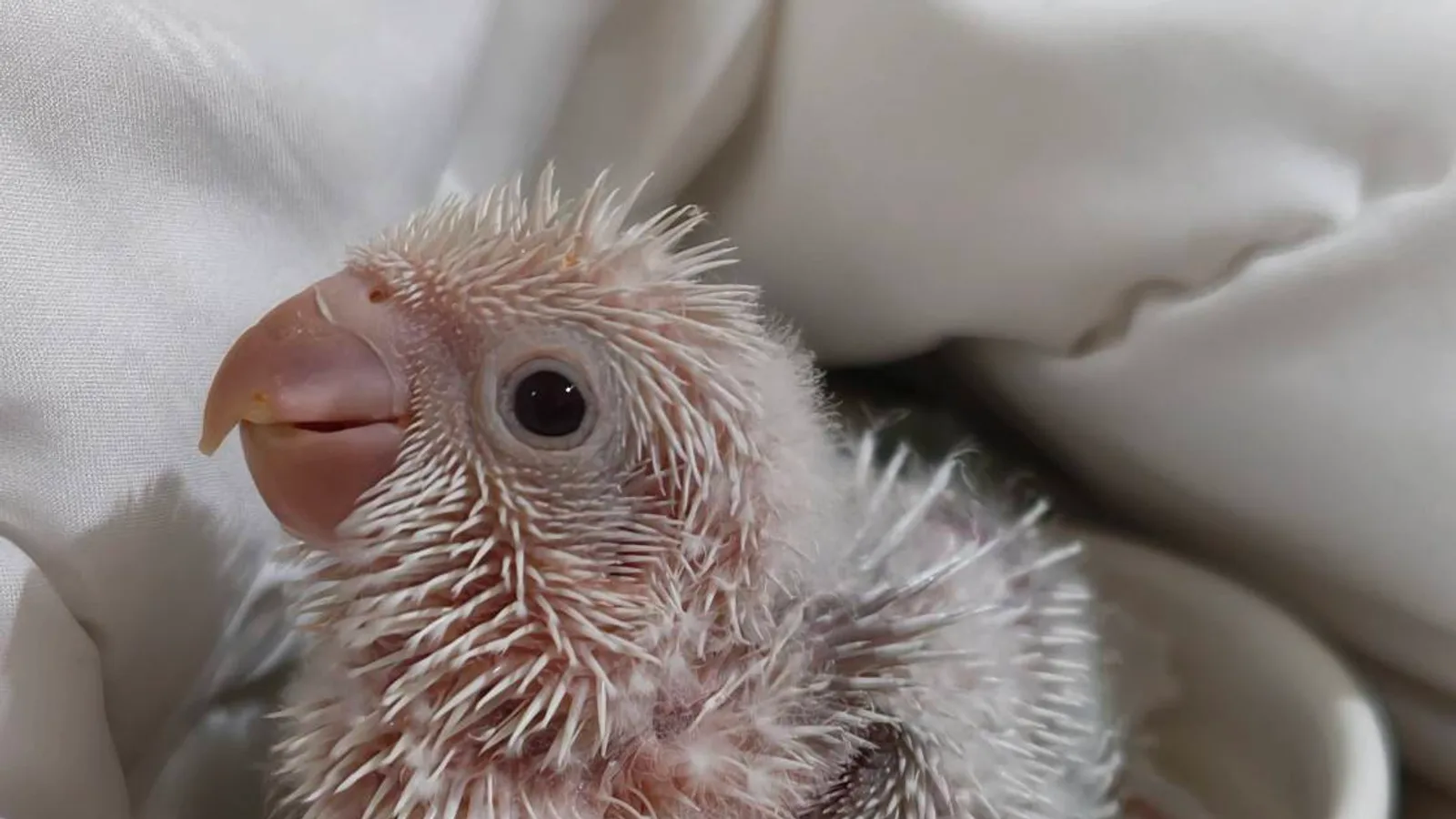
Hand feeding a monk parakeet chick is not as hard as most beginners fear. What actually kills a chick overnight is usually something small and easy to overlook: formula a few degrees too hot, a second feed poured on top of a crop that never emptied, or a mix so thick the bird quietly dehydrates. This guide comes from raising many clutches of monk parakeets on our own home. It is written so that someone who has just brought home their first hand fed chick can finish reading and feed with confidence, and know exactly when to stop feeding and get to a vet.
What you need before you start hand feeding
You genuinely only need 5 things: a parrot hand feeding formula, a syringe or feeding spoon, a thermometer for the formula, a digital scale, and a brooder box that can hold heat. Everything else makes life easier but is optional.
- Commercial parrot hand feeding formula. Choose a product labelled as a hand feeding formula for parrots. Never use baby cereal, rice porridge, cow's milk, or homemade chicken feed mixes. They are nutritionally incomplete and hard for a chick to digest.
- Syringes in 1, 3, 5, 10 and 20 ml sizes, moving up as the chick grows. A curved feeding spoon, which many Thai keepers prefer, works just as well.
- Thermometer, either a probe type or an infrared gun. It costs a few hundred baht and will save more chicks than anything else on this list.
- Digital scale accurate to 1 gram, or 0.1 gram if you can get one. Weigh the chick every morning before the first feed.
- Brooder box or incubator. A lidded plastic tub lined with tissue paper or a short pile towel, with a heat source such as a lamp or heat mat.
- Boiled water, a mixing cup, tissues, cotton wool, and a notebook for recording weight and the amount fed at each meal.
If you have never hand fed a bird before, I recommend taking a monk parakeet chick at 3 to 4 weeks or older, once the eyes are open and pin feathers are coming through. At this stage the chick is strong enough to forgive small mistakes. Chicks under 2 weeks should stay with the parents or an experienced breeder. Current Thai market prices for hand fed chicks run about 5,000 to 9,000 THB for a standard green, 10,000 to 16,000 THB for a green split, 15,000 to 25,000 THB for a blue, and 20,000 to 40,000 THB for Opaline, Turquoise, Lutino and combination mutations. Prices shift with the season, how tame the bird is, and its genetics.
Which formula to use, how to mix it, and how warm it should be
Use a commercial parrot hand feeding formula and nothing else. Mix it with boiled water and feed at 38 to 40 degrees Celsius. Below 36 degrees the chick digests slowly. Above 42 degrees you risk crop burn, which is one of the leading causes of death for chicks in a beginner's hands.
My method is to boil water and let it cool to about 50 to 55 degrees, pour it over the powder and stir until there are no lumps, then let it stand for 1 to 2 minutes so the powder fully absorbs the water. Check the temperature again right before feeding. Never microwave the formula. Heat spreads unevenly, so the outside can feel warm while the centre hits 60 degrees without showing on a surface reading.
Consistency changes with age. Chicks under 1 week get a very thin mix, 1 part powder to 5 or 6 parts water. From 1 to 3 weeks use 1 part powder to 3 parts water, about the thickness of cream soup. From 3 weeks onward use 1 part powder to 2 or 2.5 parts water, about like yoghurt. If in doubt, go thinner. Formula that is too thin just makes the chick hungry sooner. Formula that is too thick dehydrates the bird and stops the crop from emptying.
Mix fresh for every feed and throw away whatever is left. Mixed formula is a perfect breeding ground for bacteria, and refrigerating then reheating it is still not safe. There is no need to add honey, vitamins or fruit juice. A commercial formula is already nutritionally balanced, and home additions cause diarrhoea far more often than they help.
How many feeds per day: feeding schedule by age
A 1 week old monk parakeet chick needs feeding every 2 to 3 hours, 6 to 8 times a day. That tapers down with age to 2 feeds a day at 7 to 8 weeks, and most chicks are off formula by 10 to 12 weeks. The table below is the schedule I use with chicks on our own home. Amounts are midpoints and should be adjusted to each bird's size.
| Age | Feeds per day | Interval | Amount per feed | Consistency | Notes |
|---|---|---|---|---|---|
| Hatch to 7 days | 6 to 8 | Every 2 to 3 hours, including overnight | 0.5 to 2 ml | Very thin, 1 powder to 5 or 6 water | Best left with the parents. Not for beginners |
| 1 to 2 weeks | 5 to 6 | Every 3 to 4 hours | 2 to 5 ml | 1 powder to 3 water | Eyes start to open. Can go 5 to 6 hours overnight |
| 2 to 3 weeks | 4 to 5 | Every 4 hours | 5 to 8 ml | 1 powder to 3 water | Pin feathers appear. The stage most breeders pull from the nest |
| 3 to 4 weeks | 4 | Every 4 to 5 hours | 8 to 10 ml | 1 powder to 2.5 water | Can go 7 to 8 hours overnight |
| 4 to 6 weeks | 3 | Morning, afternoon, evening | 10 to 12 ml | 1 powder to 2 or 2.5 water | Nearly fully feathered, starts flapping |
| 6 to 8 weeks | 2 to 3 | Morning and evening | 12 to 15 ml | 1 powder to 2 water | Start offering solid food to explore |
| 8 to 10 weeks | 1 to 2 | Mainly evening | 10 to 15 ml | 1 powder to 2 water | Eating some on its own. Weight may dip slightly |
| 10 to 12 weeks | 0 to 1 | Evening, only if the bird begs | As much as it asks for | 1 powder to 2 water | Fully weaned once eating alone with stable weight |
I want to stress that the table is only a framework. The real rule is feed when the crop is nearly empty, not by the clock. If feeding time arrives and the crop is still half full, wait. Do not top it up. Old food left sitting in the crop starts to sour and sets off a chain of problems.
From 3 weeks on, chicks can go 7 to 8 hours overnight without a feed. Give the last feed around 10 or 11 pm and the first feed at 6 or 7 am. Letting the crop empty completely once a day is actually a good thing, because it flushes out everything old.

How to hand feed a monk parakeet chick step by step
Three things matter most: feed slowly, feed from the left side of the beak angled toward the right, and follow the chick's own swallowing rhythm. The oesophagus runs down the right side of the throat while the windpipe sits centre left, so angling toward the right greatly reduces the chance of aspiration.
- Wash your hands. Weigh the chick before the first feed of the day and write it down.
- Mix formula at the right consistency for its age, check it reads 38 to 40 degrees, and draw it into the syringe.
- Set the chick on a towel on a table. Support under the chin and beside the head gently with thumb and forefinger so the head stays upright. No squeezing.
- Touch the syringe tip to the left corner of the beak and wait for the chick to open up and start bobbing its head. This is the feeding response, and it tells you the bird is ready to swallow.
- Slide the tip in from the left side of the beak, pointing toward the right of the throat, and push the formula slowly in time with the head bobbing.
- The moment the chick stops bobbing to breathe, stop pushing. Wait until it begs again before continuing. Never push while the bird is not swallowing.
- Stop when the crop feels round and soft like a water balloon that is half full, not stretched so tight the skin looks glassy or the veins stand out.
- Wipe the beak and surrounding feathers straight away with cotton wool dipped in warm water. Dried formula around the beak causes feather loss and can deform the beak.
- Return the chick to the brooder, note the amount fed, and rinse the syringe in hot water immediately.
If you are spoon feeding, take only half a spoonful, rest the edge of the spoon on the lower beak and tilt so the formula flows as the chick sucks. It is slower and messier, but the chance of aspiration is low because the bird controls the pace entirely. This is the better method for someone feeding their first chick.
How much to feed per meal
As a rough guide, feed 10 to 12 percent of body weight per meal. A 50 gram monk parakeet chick takes about 5 to 6 ml, and a 100 gram chick about 10 to 12 ml. In the end, though, go by the crop. The numbers are only a starting point.
Newly hatched monk parakeets weigh about 6 to 8 grams, grow very fast over the first 3 weeks, and peak at around 100 to 130 grams at 6 to 7 weeks before dropping slightly at weaning. These figures vary by bloodline and the size of the parents. More important than any number is that weight goes up every single day until the chick is fully feathered.
Weigh at the same time every morning before the first feed. If weight stalls or drops for 2 days in a row before 6 weeks of age, something is definitely wrong. Check the brooder temperature, the formula consistency, and whether the crop is emptying, straight away. The scale is the only tool that reveals a problem before the chick shows any symptoms.
Look at the crop after every feed. It should be round, soft, and give slightly when pressed. If it is stretched so tight the skin looks transparent, you have overfed. A crop that is overstretched repeatedly loses its elasticity and cannot contract properly to move food along, which leads to chronic slow crop later on.
What temperature should the brooder be
Chicks with no feathers need 32 to 35 degrees Celsius. Once pin feathers appear, drop to 28 to 30 degrees, and once fully feathered they can live at normal room temperature in this part of the world. Warmth matters as much as food. A cold chick cannot digest, and even if you do everything else right the crop will not empty.
| Chick stage | Brooder temperature | Ideal humidity | Signs of too hot | Signs of too cold |
|---|---|---|---|---|
| No feathers, eyes closed | 32 to 35 degrees | 50 to 60 percent | Open beak panting, bright red skin, squirming away from heat | Cold to the touch, huddling, shivering, crop not emptying |
| Pin feathers, eyes open | 28 to 30 degrees | 50 to 60 percent | Wings held out, panting | Curled up, lethargic, not begging |
| Nearly fully feathered | 26 to 28 degrees | Normal room | Wings out, panting | Fluffed up, shivering |
| Fully feathered, learning to fly | Room temperature | Normal room | Retreating to the cool corner | Fluffed up, tucked in a corner |
Our tropical climate has one big advantage: in the hot season you barely need supplemental heat after 3 weeks of age. The flip side is that a lidded plastic tub in a warm room can climb past 38 degrees without you noticing. In the cool season or in an air conditioned room, always run a lamp or heat mat, and place the thermometer inside the box at the chick's level rather than reading the room air.
Give the box a warm end and a slightly cooler end by placing the heat source on one side only. The chick will move to where it feels right. If it is always pressed into the cool corner, it is too hot. If it is always pressed against the warm end, it is still cold.

Warning signs that need immediate action
The 3 most dangerous signs are a crop that will not empty, formula coming out of the nostrils or choking, and no weight gain for 2 days running. If you see any one of these, stop feeding by the schedule and find the cause first. If things do not improve within a few hours, take the chick to a vet who sees birds.
- Crop not emptying for more than 4 to 6 hours, or still full the next morning. Usually caused by a cold chick, formula that is too thick, or infection. Never feed on top of it. Raise the temperature, give 1 to 2 ml of warm water or avian electrolyte solution, and gently massage the crop from top to bottom. If it still has not emptied in 3 to 4 hours or smells sour, that is sour crop and it needs a vet.
- Formula from the nostrils, coughing, or rattling breathing. The chick has aspirated formula into the windpipe. Stop feeding at once, hold the bird head up, and clear the nostrils. If breathing is still noisy after 10 to 15 minutes, go to the vet, because formula in the lungs turns into pneumonia within 1 to 2 days.
- Crop skin dark red, with white spots or a scab. Almost always crop burn from formula above 42 degrees. The crop wall is burned and can perforate within 2 to 3 days. Go to the vet immediately. Do not wait and watch.
- Skin deep red, dry and wrinkled like an old person's. This is dehydration, usually from formula that is too thick or a brooder that is too hot. Thin the formula and give an extra 1 to 2 ml of warm water between feeds.
- No weight gain or weight loss for 2 days in a row before weaning. Check temperature, consistency, and crop emptying. If everything looks normal and weight still will not rise, there is usually a hidden infection.
- Cold, lethargic, no head bobbing when you touch the beak. A chick with no feeding response is already sick. Warm it for 20 to 30 minutes and try again. If it still does not beg, do not force feed. It will aspirate for certain.
- Swollen belly, watery droppings, bright green droppings, or an unusually foul smell. These point to bacteria or yeast in the digestive tract. If you also see white patches in the mouth, move even faster.
- Legs splaying out to the sides, known as splayed legs. This is not a feeding problem but a slippery floor problem. Switch the lining to a short pile towel or crumpled paper. The sooner you fix it, the more easily it corrects.
The most common mistake when something goes wrong is that the feeder worries the chick is hungry and pushes more formula in while the old food is still sitting there. A monk parakeet can go half a day without food and be fine if it is warm enough, but a crop holding soured formula for half a day can be fatal. An empty crop is always safer than a crop full of old food.
When does a monk parakeet chick wean
Most monk parakeet chicks wean themselves between 9 and 12 weeks. Start offering solid food to explore from 6 weeks, drop the midday feed first, then the morning feed, and keep the evening feed as the last one to go. Some birds wean early at 8 weeks and others as late as 14 weeks. Both are normal.
Early weaning foods should be soft and easy to pick up: parrot pellets soaked in warm water until soft, boiled corn, boiled pumpkin, cooked brown rice, and sprays of millet to gnaw on. Put them in a shallow dish the chick can walk to easily and replace every 3 to 4 hours, because food spoils fast in our heat.
A weight drop of 10 to 15 percent from the peak during weaning is normal. The body is converting baby fat into flight muscle. If the drop is bigger than that or the bird goes quiet, go back and add 1 feed. Never force weaning by the calendar. A Quaker parrot that is pushed to wean too early often turns into an anxious bird that keeps begging for months.
If you collect a chick from a breeder at 6 to 8 weeks, ask exactly how many feeds a day it is getting and how many ml per feed, then keep that routine unchanged for at least 1 week. Quaker parrots, or monks as we call them here, slip back into begging very easily after a change of home. Giving the bird time to settle matters more than rushing to wean.
Mistakes beginners make most often
Almost every hand fed chick lost in a beginner's care comes down to the same handful of mistakes. Avoid all of them and your first monk parakeet chick has better than a 90 percent chance of making it.
- Microwaving the formula, or testing the heat on the back of the hand instead of with a thermometer. Your hand cannot tell 40 degrees from 46, but the chick's crop can, and it burns.
- Feeding by the clock when the crop has not emptied.
- Mixing the formula too thick for fear the chick is not full, then dehydrating it without realising.
- Not weighing daily, so by the time you notice symptoms the bird has already been sick for 2 or 3 days.
- Saving mixed formula for the next feed, or reusing the same syringe without washing between feeds.
- Letting everyone in the house take turns cuddling the chick through the day. An unfeathered chick needs to sleep 90 percent of the time, and constant disturbance slows growth and invites illness.
- Keeping the chick on a smooth, slippery surface until the legs splay.
- Taking on a chick under 2 weeks old with no experience, because it was cheaper.
To anyone about to start: the monk parakeet is tougher and smarter than most parrots its size. If you control the formula temperature, wait for the crop to empty before feeding, and weigh every morning, those 3 habits alone will carry you through the hand feeding stage. The tameness and the talking will follow on their own from all those hours you spend feeding your Quaker parrot several times a day, without any extra effort at all.
Frequently asked questions
How old should a monk parakeet chick be before a beginner takes it on for hand feeding?
At least 3 to 4 weeks, with eyes open and pin feathers coming through. At this stage the chick takes 4 feeds a day, tolerates small mistakes, and does not need overnight feeds.
Do I have to get up at night to feed the chick?
Not after 3 weeks of age. Give the last feed around 10 or 11 pm and the chick can go 7 to 8 hours. Chicks under 2 weeks still need feeding every 3 to 4 hours, including overnight.
I do not have a thermometer. Can I test the formula on the back of my hand or wrist?
Not recommended. Human skin can barely tell 40 degrees from 46, but that difference is enough to burn a chick's crop. A probe thermometer costs under 200 THB. Just buy one.
Can I refrigerate mixed formula and use it for the next feed?
No. Mixed formula grows bacteria very quickly even when chilled, and reheating makes the temperature hard to control. Mix fresh every feed and discard the leftovers immediately.
My monk parakeet chick regurgitates after feeding. What should I do?
Check 3 things: whether you overfed until the crop was tight, whether the formula was too hot or too cold, and whether the crop smells sour. A single episode with a bright, active chick is usually nothing to worry about. Repeated regurgitation or a sour smell means a vet visit.
Syringe or spoon, which is better?
The spoon is safer for beginners because the chick controls its own swallowing and the risk of aspiration is low. The syringe is faster and measures amounts more accurately, so it suits people who are already confident or feeding several chicks.
Does a hand fed monk parakeet chick need extra plain water?
Normally no. Correctly mixed formula is already 70 to 80 percent water. Give an extra 1 to 2 ml of warm water only when the chick shows signs of dehydration, the crop is emptying slowly, or the weather is very hot.
Based on hands-on breeding and keeping experience, reviewed at every update · Published 8 Sept 2026