How to Tame a Monk Parakeet in 30 Days: Step Up Training From a Working Breeder
 Written by the NokMonk team, monk parakeet breeders in ThailandUpdated 12 Sept 2026Read time 13 min
A 30 day plan to tame your monk parakeet: build trust, teach step up, and play together, plus a daily schedule and how to handle biting.
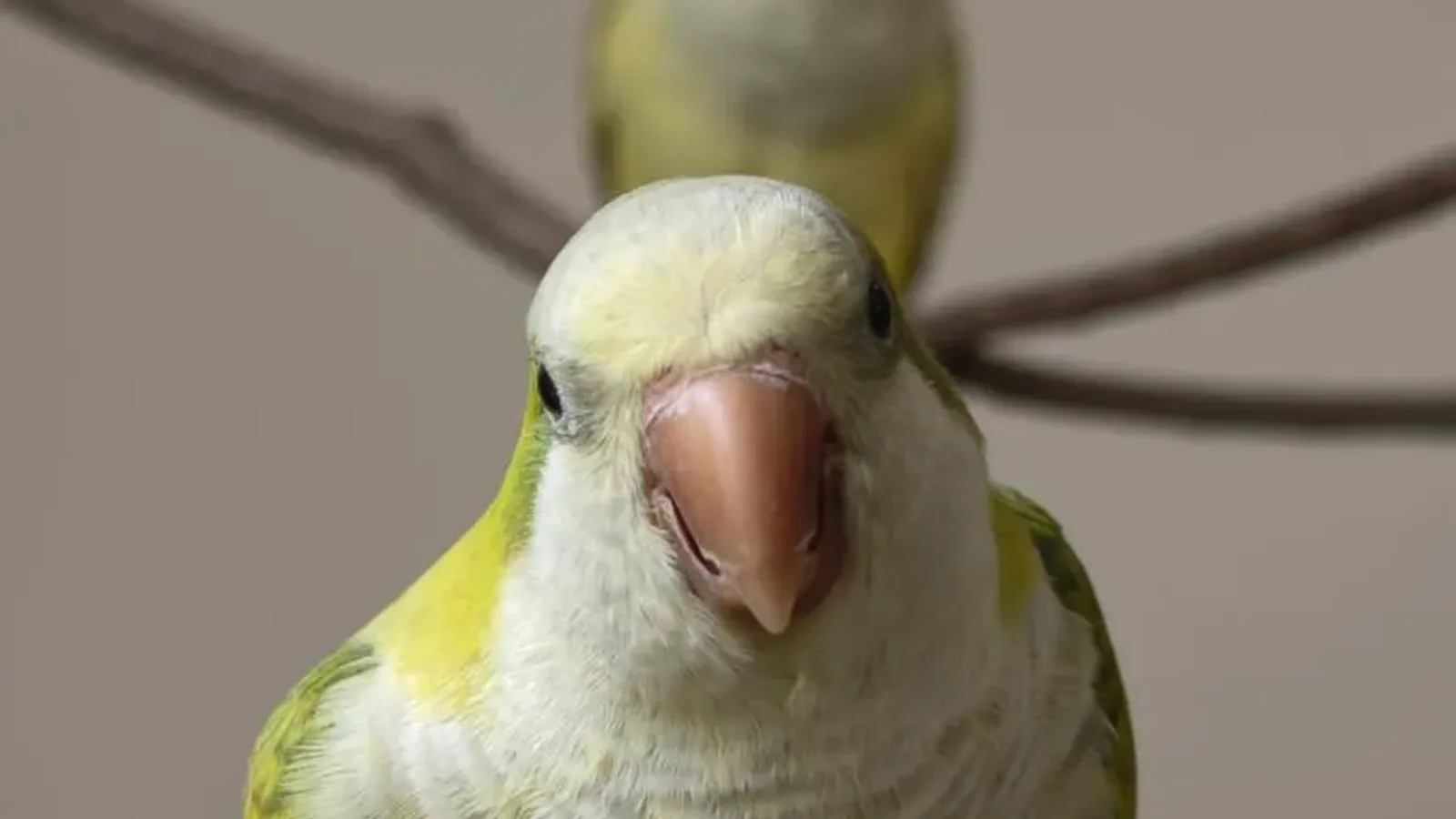
The monk parakeet, also known as the Quaker parrot, is a medium sized parrot that tames far more easily than most people expect. I have kept and bred monk parakeets for many years, and I have seen birds become hand tame in 2 weeks and birds that owners have kept for over a year and still cannot touch. The difference is rarely the bird alone. It comes down to the method and how consistent the owner is.
This article lays out a realistic 30 day plan, from the day your bird arrives home to the day it flies over and lands on your hand by itself. I have split it into 3 main phases: building trust, teaching the step up command, and taking the bird out to play with you. Every phase has a clear sign that tells you whether the bird has passed it, so you never rush ahead and frighten the bird.
Can you really tame a monk parakeet in 30 days?
Yes, if the bird is a hand fed baby between 2 and 5 months old and you train every day, 2 sessions of 10 to 15 minutes each. Older birds and parent raised birds can be tamed too, but give yourself 2 to 3 months instead.
Monk parakeets are easy to train because they are flock birds. In the wild they live in groups of dozens or even hundreds and build huge communal stick nests together. Their basic nature is to want company, to enjoy attention, and to learn fast. If you can become part of their flock, the bird will want to be with you on its own.
This also affects price directly. On the Thai market right now, a hand fed baby in the ordinary green colour goes for 5,000 to 9,000 THB, a green split for 10,000 to 16,000 THB, and a blue for 15,000 to 25,000 THB. Opaline, turquoise, lutino and combination mutations sit at 20,000 to 40,000 THB. These are Thai market prices and they move with the season, genetics and tameness. A bird that already steps onto a hand always sells for more than one that is still afraid of people, so the 30 days you invest in training pay for themselves.
What do you need before you start training a monk parakeet?
You need 3 things: a cage position where people walk past often, a treat the bird genuinely loves, and a training time that is the same every day. Miss any one of these and the 30 day plan will stretch out by several weeks.
For cage position, I recommend the living room or any corner where the family spends a lot of time. The cage should sit roughly between chest and eye level. Do not place it above head height, because the bird will feel it is higher up than you, and do not place it on the floor, because the bird will feel unsafe.
For treats, work out what this particular bird likes most, then reserve that item for training only. Never put it in the daily food bowl. Most monk parakeets go for the following:
- Millet spray is the number 1 choice and works brilliantly for training through the cage bars
- Raw sunflower seeds, 1 seed at a time and no more than 5 to 6 seeds a day, because they are very fatty
- Fresh corn cut into kernels, ripe papaya, and apple cut into small pieces
- Fruit flavoured pellets, if the bird already eats them
Finally, equipment. Have 1 free standing perch (a T-stand), a room with the fan off, the windows shut, and any cables tucked away. If the bird has just arrived, give it 3 to 5 days to settle in first. Just feed it, change the water, and talk softly. Do not start training yet.
Week 1: build trust, no handling yet
The first 7 days have a single goal: the bird takes a treat from your hand without backing away. Do not try to pick it up, do not take it out of the cage, and never chase it to grab it. A single grab can undo a whole week of trust building.
Take it day by day like this:
- Days 1 to 2: sit about 1 metre from the cage, 2 sessions of 10 minutes a day. Talk softly, read a book, or scroll your phone. The point is for the bird to get used to having you nearby.
- Days 3 to 4: move your chair right up to the cage and offer millet spray through the bars. Hold it perfectly still. If the bird will not come to eat, rest it on the edge of the cage and step back.
- Days 5 to 7: open the cage door, slowly move your hand holding the millet inside, rest it on the cage floor or a perch, and freeze. Let the bird walk over and eat on its own.
Use this week to learn the bird's body language too. A relaxed bird fluffs its feathers slightly, half closes its eyes, and may grind its beak gently. A frightened bird pulls its feathers tight against its body, leans backwards, and turns sideways to you. A bird about to bite puffs up its neck feathers, opens its beak, and lowers its head. If you see fear or a coming bite, pull your hand back a little and wait. Do not push on.
You have passed this week when the bird walks over and eats from your hand inside the cage for 2 to 3 days in a row without hesitating. If it is not there yet, stay at this stage. There is no rush.

Week 2: teach step up onto your hand
Step up means the bird climbs onto your finger when it hears the command. To teach it, hold your index finger against the bird's chest just above the legs, say a short cue such as "up", and give a treat the moment the bird steps on. This is the single most important foundation command for any pet parrot.
Each session runs in this order:
- Hold the treat in your other hand where the bird can see it but cannot reach it.
- Bring your index finger in parallel to the perch, about 1 to 2 centimetres higher than the perch the bird is standing on.
- Touch the chest gently and say "up" in the same tone every single time.
- Wait 3 to 5 seconds. Most birds lift one foot onto the finger first. The instant a foot touches your finger, praise the bird and give the treat.
- Repeat until the bird steps up with both feet, reward again, then return it to the same perch.
Do 5 to 8 repetitions per session, 2 sessions a day. Once the bird steps up reliably, teach step down as well. Hold your finger slightly below the perch, say "down", and let the bird step back onto it. A bird that knows how to get on but not off will grip your hand so hard you cannot put it down.
I see 3 common mistakes. The first is pushing the finger so hard the bird loses its balance. The second is lifting your hand high or walking off the moment the bird steps on, which startles it into flying away. Early on, hold still inside the cage. The third is rewarding too slowly, so the bird cannot connect the treat with what it did. Deliver the treat within 1 to 2 seconds of the correct action.
Weeks 3 to 4: out of the cage and starting to play together
Once the bird steps up solidly inside the cage for 3 days running, you can start taking it out. In these last 2 weeks the goal is for the bird to stay on you for longer and longer, and to start enjoying activities with you, so it learns that being with you beats being in the cage.
On the first days, have the bird step up, then slowly withdraw your hand from the cage and carry it to a T-stand no more than 1 metre away. Reward, then take it back to the cage. That is enough. When the bird is calm with this, add distance and time outside the cage in 5 minute steps. By day 30 the bird should be able to sit on your arm or on a T-stand beside you for 30 minutes to 1 hour without getting restless.
About shoulders: I recommend getting the bird comfortable on your hand and arm first, and only allowing the shoulder from around day 25 onwards. On your shoulder you cannot read the bird's body language, and if it gets a fright it will bite close to your face.
Games you can play with a monk parakeet from week 3:
- Target training: use 1 wooden chopstick as a target stick. Offer it and reward the bird for touching it with its beak. Once the bird understands, you can lead it anywhere just by moving the chopstick. This is the base for every trick that follows.
- Destructible chew toys: cardboard, ice cream sticks, and balsa wood. Offer them while the bird sits on your lap. Monk parakeets live to destroy things and will play like this for a long time.
- Treats hidden in paper: wrap a sunflower seed in a scrunched tissue and let the bird unwrap it.
- Head scratches: start by touching the beak with a fingertip. If the bird does not pull away, stroke up to the forehead and the back of the neck, against the feathers. A monk parakeet that trusts you will lower its head and ask for more.
The 30 day monk parakeet training schedule, day by day
This table condenses the whole plan into 5 stages, each with a sign that tells you the bird has passed. Go by the sign, not by the date. If the bird has not passed, simply stay in the same stage.
| Days | Goal | What to do each day | Time per session | Passed when |
|---|---|---|---|---|
| Days 1 to 3 | Bird gets used to you | Sit beside the cage 2 sessions, talk softly, no hands yet | 10 minutes | Bird eats normally while you sit beside the cage |
| Days 4 to 7 | Eats treats from your hand | Offer millet spray through the bars, then hand inside the cage, 2 sessions | 10 minutes | Bird walks over and eats from your hand inside the cage 3 days in a row |
| Days 8 to 14 | Step up inside the cage | Practise step up and step down 5 to 8 times per session, 2 sessions | 10 to 15 minutes | Bird steps onto your finger as soon as it hears the cue 3 days in a row |
| Days 15 to 21 | Short trips outside the cage | Step up, carry to a T-stand 1 metre away, start target training, 2 sessions | 15 minutes | Bird sits on the T-stand beside you for 15 minutes without flying back to the cage |
| Days 22 to 30 | Plays with you and stays on you for longer | Add 5 minutes outside the cage each day, play with toys, practise head scratches, try the shoulder, 2 sessions | 20 to 30 minutes | Bird walks or flies to you on its own when you hold out your hand |
Treat quantity matters too. Monk parakeets gain weight very easily, and if they get too many treats in a day they fill up and lose interest in training. I stick to the amounts below.
| Training treat | Amount per day | Best for |
|---|---|---|
| Millet spray | A sprig no longer than 5 centimetres, split across 2 sessions | Days 1 to 14 |
| Raw sunflower seeds | No more than 5 to 6 seeds | Days 8 to 30, as the reward for step up |
| Fresh corn, papaya, apple | About 1 tablespoon combined | Days 15 to 30, for games outside the cage |

What to do when your monk parakeet bites during training
Do not hit, do not shout, do not flick your hand. Stay still, quietly set the bird down on its perch or the T-stand, then turn your back and walk away for 1 to 2 minutes. The one thing a monk parakeet cannot stand is being ignored. Being ignored is a punishment 100 times more effective than a scolding.
Before you fix it, work out why the bird bit. Quaker parrots bite for 4 main reasons:
- Fear: common in the first week. It means you are moving too fast. Go back a stage.
- Cage territoriality: monk parakeets are unusually protective of their nest. Many birds are perfectly tame outside the cage but bite the moment a hand comes inside. If this is your bird, open the door and wait for it to walk out on its own, or offer a perch instead of your hand.
- Wanting to go back to the cage: if the bird bites while outside and you return it to the cage straight away, it learns that biting gets it home. Hold still for 10 seconds before taking it back.
- Hormones: birds over 1 year old get irritable in breeding season. During this period, cut back on stroking the body, scratch only the head, and keep the bird away from boxes or dark corners it might treat as a nest.
If the bird bites hard enough to draw blood every time you reach in, go back to training through the bars for another week, and use a short perch instead of your finger for step up until the bird relaxes, then switch back to your finger. I have worked with plenty of heavy biters. Every one of them came around in the end, as long as the owner never answered with force.
Why is my monk parakeet still not tame after training?
The most common cause is inconsistent training combined with skipping ahead before the bird is ready. Train for 3 days and stop for 4, and the bird starts from zero almost every time.
Beyond that, run through this checklist:
- Sessions are too long. Monk parakeets have short attention spans, and 10 to 15 minutes is the sweet spot. At 30 minutes the bird gets bored and starts biting.
- The treat is not exciting enough. If it is something the bird already gets in its food bowl, there is no reason to come and take it from you.
- Free treats all day. Someone in the house is slipping the bird snacks outside training time.
- People in the house are not consistent. One person trains properly, another grabs at the bird, and the bird ends up trusting nobody.
- The cage is in a quiet room nobody walks through, so the bird only sees people for 20 minutes a day during training.
- The bird is moulting. It feels itchy and irritable and does not want to be handled. Train lightly during this time and just maintain the bond.
- The bird was handled roughly in the past. Expect 2 to 3 times as long as a normal bird.
You also have to accept that every bird has its own personality, even hand fed chicks from the same clutch. Some step up on day 5, others take 3 weeks. If your method is right and you are consistent, a slow bird gets there just the same.
Can an adult or parent raised monk parakeet be tamed?
Yes, but stretch every stage out 2 to 3 times longer, and accept in advance that the bird may end up "tolerating your hand" rather than "loving to be handled". Many adult birds never enjoy head scratches, but they step up, ride on your hand, and sit on your shoulder just fine.
For adult birds I use the same plan with 3 adjustments. First, stay at the through the bars stage for longer, perhaps 2 to 3 weeks, until the bird eats from your hand with no hesitation at all. Second, start target training while the bird is still inside the cage, so it follows the chopstick onto your hand instead of you pressing a finger against its chest, because adult birds often dislike being touched. Third, use a short perch for step up for at least 1 week before switching to your finger.
The upside of an adult bird is that once tame, it is usually calmer and steadier than a hand fed baby and less spooked by new things. I have a parent raised bird, 3 years old, that took almost 3 months to step up. Today it is the easiest bird on the whole breeder to take anywhere.
One last thought. Taming a monk parakeet is not about winning against the bird. It is about convincing the bird that your hand is the safest place in the house. Two short sessions a day, patience through every stage, no skipping, no force. After 30 days you will have a Quaker parrot that flies to you every time you open the cage door, and that is the moment every parrot owner is waiting for.
Frequently asked questions
Should I clip my monk parakeet's wings before training?
Not necessary. I train fully flighted birds on this 30 day plan without any trouble. If you do clip, trim only the outer flight feathers so the bird can still glide to the floor, never so much that it drops like a stone. And understand that a clipped bird tames faster because it cannot escape, not because it trusts you more.
Is it better to train in the morning or the evening?
Morning, before the first meal, works best because the bird is slightly hungry and keen on treats. Do the second session in the evening, about 1 hour before the bird goes to sleep. Avoid the afternoon, when most birds nap.
My monk parakeet is tame with one person and will not let anyone else in the house touch it. How do I fix that?
This is very normal for monk parakeets, which tend to pick one favourite person. The fix is to have the other family members hand out the training treats every day while the favourite steps back for a while. In the early days, have the others ask for step up from the favourite person's hand first.
Can I train 2 monk parakeets at the same time?
Yes, but it is much slower than with a single bird, because the pair will be far more interested in each other than in you. If you want both tame, house them in separate cages and train them one at a time in a room where the other bird cannot see.
Should I use English or Thai for the commands?
Any language works, as long as you use the same word in the same tone every time. Birds remember the sound, not the meaning. Most Thai owners use the Thai words for "up" and "down" simply because they are short and easy to say.
If I do not handle the bird for several days after training, will it go back to being afraid of people?
A fully tame bird is usually fine after a gap of 3 to 7 days. After a gap of a month, though, it will get wary and may bite at first. Go back to step up with treats for 2 to 3 days to rebuild the familiarity.
Can I train during a moult?
You can, but lower your expectations. A moulting bird is itchy and irritable, so skip the body stroking and head scratches. Stick to step up and hand feeding treats to maintain the bond until the new feathers have fully grown in.
Based on hands-on breeding and keeping experience, reviewed at every update · Published 8 Sept 2026