How Big Should a Monk Parakeet Cage Be? Size, Bar Spacing, Perches, Toys and Condo Setup
 Written by the NokMonk team, monk parakeet breeders in ThailandUpdated 12 Sept 2026Read time 13 min
A monk parakeet cage should be at least 60 cm wide with bar spacing under 1.5 cm. A breeder's guide to perches, toys and where to put the cage in a home or cond
When someone brings home a hand fed monk parakeet baby, the cage is usually the first thing they ask me about. It is also the thing I see people get wrong most often. Many buy whatever the shop recommends, or reuse an old budgie cage they already have at home. Two or three months later the bird is chewing the bars, the tail feathers are all broken, or worse, the bird gets its head stuck between the bars.
This article pulls together what I have learned from keeping and breeding monk parakeets for many years. It covers cage size, bar spacing, choosing perches and toys, and where to put the cage in a house or a small condo with limited floor space. By the end you should be able to choose the right cage the first time and not pay twice.
How big does a monk parakeet cage need to be?
A cage for a single monk parakeet should measure at least 60 x 45 x 60 cm (width x depth x height). If you can, go for 60 x 60 x 90 cm or larger. If the bird will spend more than 8 hours a day inside, bigger is always better.
The reason is that monk parakeets are larger than most people expect. An adult is around 28 to 30 cm long including the tail and weighs roughly 90 to 120 grams. They are also busy birds that love to climb, work and pull things apart. A cage that is too tight leaves no room to open the wings, the tail feathers rub against the bars until they break, and stress behaviours like bar chewing and feather plucking start to appear.
The simple rule I use is this. The bird must be able to stretch both wings fully without touching the bars. It must be able to hop from one perch to another at least 1 or 2 times across the cage. And there must still be open space left after the food cup, water cup and toys are all in. If the bird can barely move once everything is installed, the cage is too small.
If you have searched for parrot cage sizes and found a confusing range of numbers, here is a table based on how the cage is actually used. Prices are current Thai market prices for standard painted steel cages and will vary by brand and shop.
| Use | Minimum size (W x D x H) | Bar spacing | Approximate price |
|---|---|---|---|
| Unweaned baby (temporary) | Brooder box or nursery cage 30 x 30 x 30 cm | Under 1.2 cm, or a solid sided box | THB 300 to 800 |
| 1 bird, out of the cage daily | 60 x 45 x 60 cm | 1.2 to 1.5 cm | THB 1,200 to 2,500 |
| 1 bird, mostly caged | 60 x 60 x 90 cm | 1.2 to 1.5 cm | THB 2,500 to 5,000 |
| 2 birds (pair or companions) | 80 x 60 x 100 cm or larger | 1.2 to 1.5 cm | THB 4,000 to 8,000 |
| Breeding cage, 1 pair | 90 x 60 x 60 cm with a wooden nest box hung outside | 1.2 to 1.5 cm | THB 3,000 to 6,000 |
| Genuine stainless steel, any size | As above | 1.2 to 1.5 cm | THB 6,000 to 20,000 |
One thing to watch for: many cages sold as small parrot cages are only around 40 x 40 x 50 cm. That is fine for a budgie or a cockatiel but too small for an adult monk parakeet. It can work as a temporary home while the bird is still a baby, but plan to buy the real cage by the time the bird is about 3 months old.
What bar spacing is safe for a monk parakeet?
Safe bar spacing for a monk parakeet is 1.2 to 1.5 cm. Never go above 1.6 cm. A young monk parakeet that is not yet full sized can push its head through a wider gap and then cannot pull it back out.
I learned this the hard way. When I first started, I used a medium parrot cage with 1.9 cm spacing. A 4 month old chick pushed its head out between the bars and got stuck by the neck. I happened to be home and freed it in time. Since then I measure the bar spacing on every cage with a tape measure before buying. I never rely on the number the shop gives me.
At the other extreme, very tight spacing of 0.8 to 1.0 cm, the kind used for finches, is not suitable either. Monk parakeets climb the bars with their feet and beak, and very narrow gaps make it hard for the toes to grip. Those cages also tend to use thin wire that a monk parakeet can chew through within a few weeks.
Beyond spacing, check the wire thickness. It should be at least 2 mm for painted cages and 1.5 mm or more for stainless steel. A monk parakeet's beak is many times stronger than a budgie's. Cheap thin wire gets bent wider and wider until the bird can squeeze out.
How to check a cage in the shop in 1 minute
- Measure the gap between bars with a tape measure or ruler at 3 or more different points. Cheap cages often have uneven spacing.
- Push the bars with your finger to see if they wobble. Easy movement means thin wire or poor welds.
- Open and close the door and check the latch. A Quaker parrot can work out a simple hook latch within days, so look for a spring latch or add a padlock or clip.
- Inspect the welds and corners for sharp wire ends sticking out.
- Smell the paint. A strong chemical smell means the coating has not fully cured. Air it out for 3 to 5 days before use.
What type of cage suits a monk parakeet best?
A rectangular cage that is slightly taller than it is wide, made from good quality powder coated steel or stainless steel, is the best choice for a monk parakeet. Round cages and bamboo cages should never be used.
Round cages look nice but have no corner for the bird to retreat to. Monk parakeets need a spot that feels safe when they are startled or sleeping, and a round cage leads to constant low level stress. The bars that converge at the top are also a classic spot for a toe or leg to get trapped. As for bamboo or wooden cages, a monk parakeet will chew its way out within a week, guaranteed.
On materials, if the budget allows I recommend genuine stainless steel. It does not rust, can be washed often, and there is no paint to flake off into the bird's mouth. If money is tighter, a powder coated steel cage with a smooth, uncracked finish works well. Just avoid cheap shiny galvanised cages. The zinc that comes off when the bird chews the bars is directly toxic to parrots.
The base should have a wire grate above a slide out tray. This makes cleaning easy and stops the bird from walking through its own droppings. A stand with wheels is a real bonus for condo living, since you can roll the cage into the bathroom for washing or out of direct sun.

What perches work best for a monk parakeet?
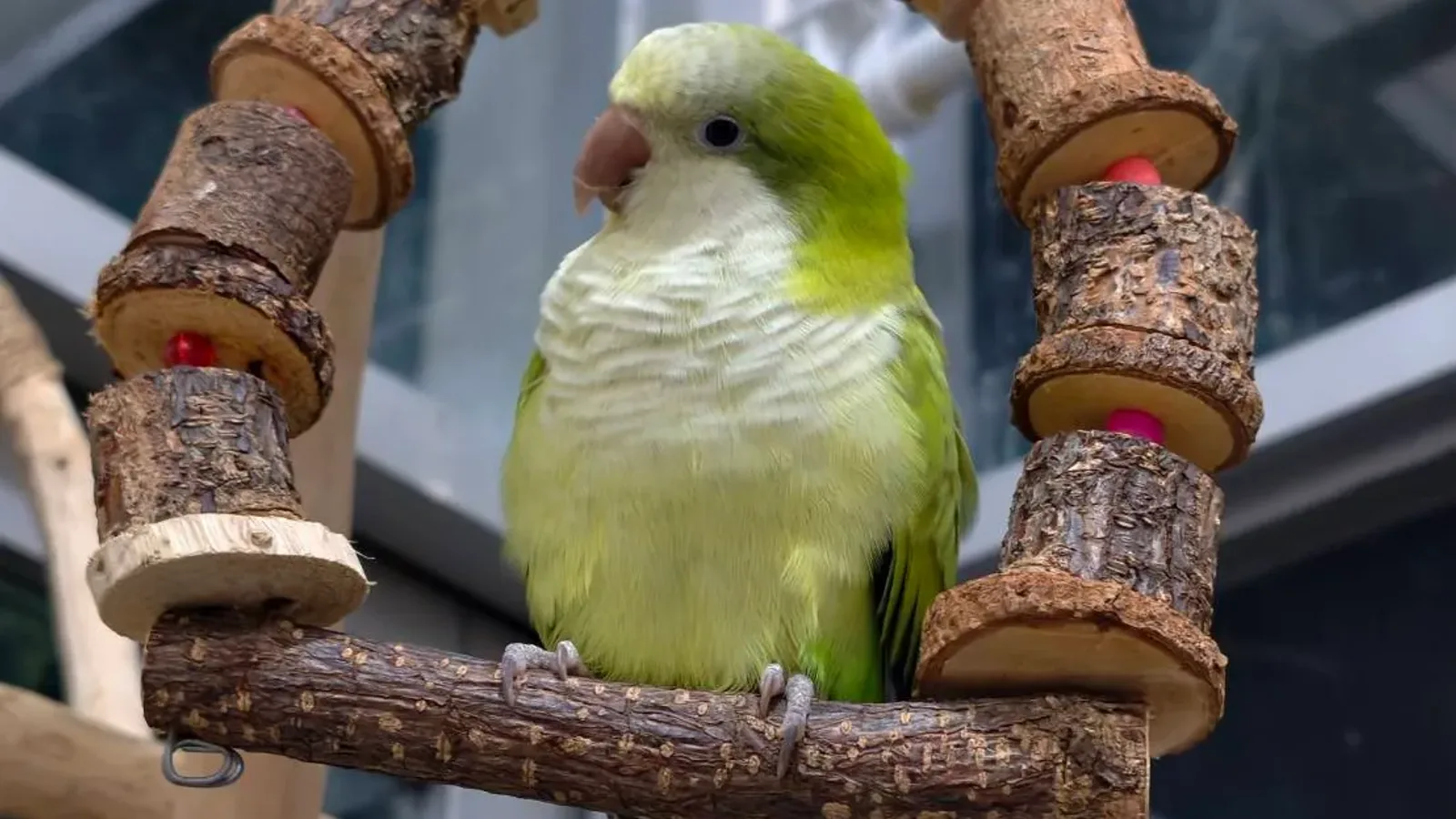
The best perches for a monk parakeet are natural wood branches of varying thickness, 1.5 to 2.5 cm in diameter, with at least 3 per cage. The foot should wrap around half to three quarters of the perch, not close all the way around or sit flat.
The smooth round plastic perch that comes with the cage is always the first thing I remove. It is the same width along its whole length and slippery, so the foot bears weight on exactly the same spot all day. In birds that spend long hours caged, this leads to sores on the underside of the foot known as bumblefoot. I also do not recommend sandpaper covered perches. They do not trim the nails as advertised. They just wear the skin on the soles.
Woods I use and consider safe are guava, mango, jackfruit, rose apple and willow. Choose fresh branches, wash them well, then dry them in strong sun for 2 to 3 days or bake them at 100 degrees for about 30 minutes to kill insects. Avoid trees with milky white sap like frangipani or bodhi, and any wood that may have been sprayed with pesticide.
Where to place perches in the cage
- Sleeping perch: highest point in the cage, near a back corner. A monk parakeet will always pick the highest and safest spot to sleep.
- Feeding perch: middle height, far enough from the food cup that the bird stretches its neck to reach, so its rear is never over the cup.
- Play perch: lower level, near the toys. A rougher branch works well here.
- Never stack perches directly above one another. Droppings from the upper perch land on the lower perch and the food cups.
Replace perches every 2 to 3 months, or whenever the bark has been chewed off and the wood underneath is getting smooth. Swapping perches regularly also makes the bird adjust its grip, and it counts as enrichment in its own right.
What toys does a monk parakeet need?
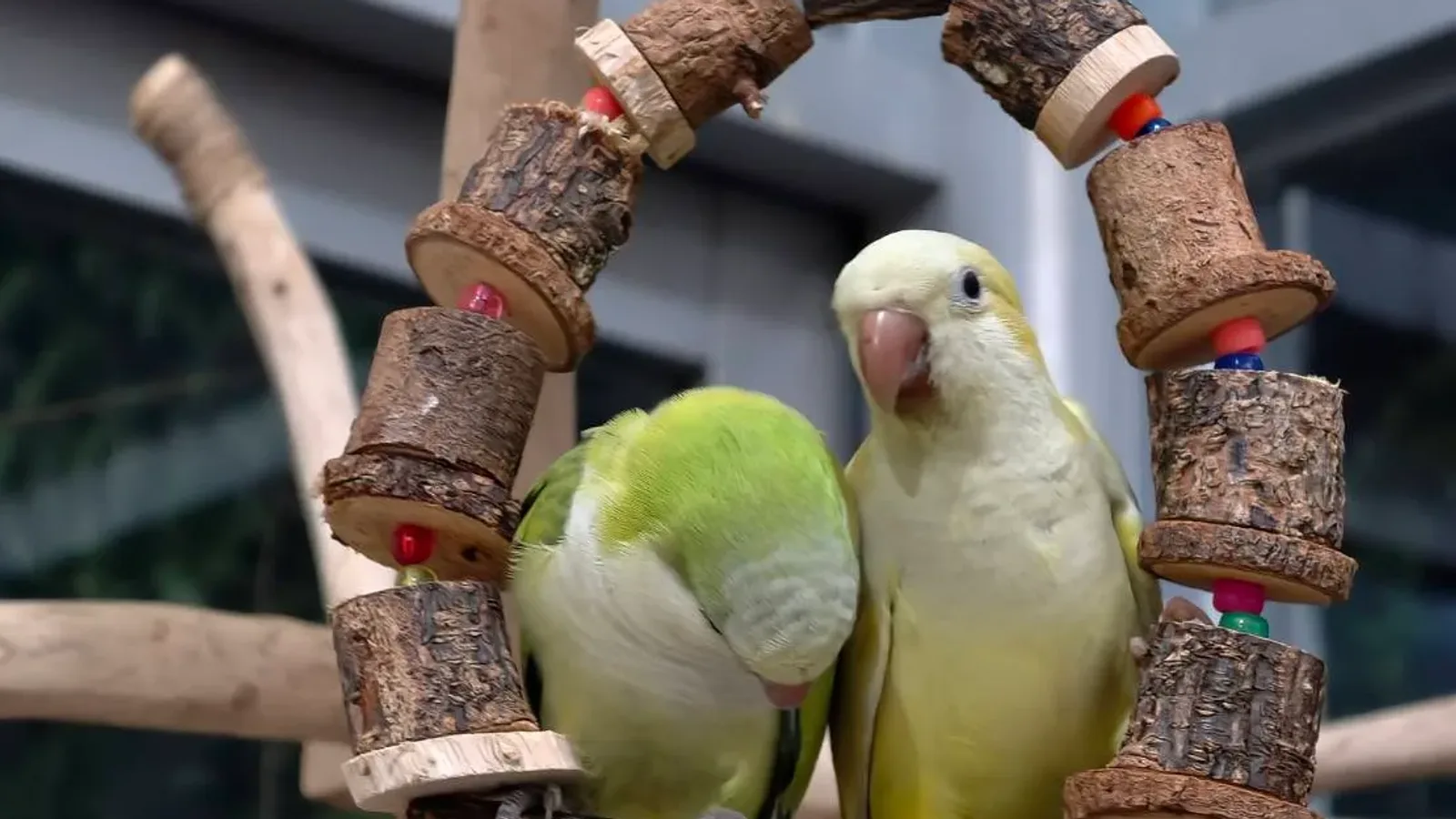
There are 3 types of toy a monk parakeet cannot do without: something to chew, something to shred, and a foraging toy. Keep 1 or 2 of each in the cage at all times and rotate in fresh pieces every 1 to 2 weeks.
It helps to understand that in the wild the Quaker parrot is the only parrot that builds its own nest, weaving twigs into huge communal structures. The instinct to pull apart, chew and arrange material is extremely strong. If there is nothing to do, that energy goes into the cage bars, the bird's own feathers, or screaming for attention. Toys are not a luxury. They are as essential as food.
Toys I keep in every cage
- Chew blocks Soft, unpainted wood such as rubberwood or pine, threaded on cotton rope and hung up. Around THB 50 to 150 each. The bird will destroy one in 1 to 2 weeks, which is completely normal.
- Shredding material Plain unprinted cardboard, empty toilet roll tubes or dried palm leaf, woven or stuffed into a rattan ball. Costs next to nothing and monk parakeets love it.
- Foraging toys Cups or boxes that must be opened, turned or pulled to release sunflower seeds or nuts. Ready made ones cost THB 150 to 400, or make your own from a toilet roll tube with the ends folded in.
- Stainless steel bell Choose one with a firmly fixed clapper inside. Never use brass or cheap plated bells, which contain lead and zinc.
- Cotton rope or a swing For hanging and climbing. Trim any frayed threads as soon as you see them, because loose strands can wrap around toes.
Toys to avoid include small plastic pieces the bird can crack, mirrors, which can make a single Quaker parrot obsessed with its reflection and aggressive toward people, and chain links with gaps just the size of a toe. Before buying anything, assume the bird will try to destroy it and ask yourself whether the pieces that come off could hurt it.
On rotation, I keep around 8 to 10 toys in circulation with 3 or 4 in the cage at a time. Every week I take out 1 or 2 and put back some from storage. The bird gets excited as if it were brand new every time, and I never need to buy more.
Where should you put a monk parakeet cage at home?
The best spot is a corner of the room where the family spends the most time, usually the living room. Put the back of the cage against a wall on at least 1 side, with the sleeping perch at standing eye level or slightly higher. Never place it in the kitchen.
Monk parakeets are flock birds and need to see and hear the members of their household. A bird left in a storeroom or on a balcony nobody passes will scream for company and become fearful or aggressive. But the middle of a room with people walking past on every side is not right either, because the bird never feels that its back is protected.
The kitchen is off limits because fumes from overheated non stick pans, smoke from frying, and gas from the stove can all kill a bird within minutes while you smell nothing at all. A bird's respiratory system is far more sensitive than ours. If you live in an open plan home where the kitchen joins the living area, put the cage as far from the kitchen as possible and run the extractor fan every time you cook.
Spots to avoid
- Directly in front of or under the air conditioning vent. Constant cold air makes birds sick.
- Beside a window in direct afternoon sun. In Thailand a metal cage heats up fast and the bird can suffer heatstroke inside it.
- Next to a loud TV or speakers. A monk parakeet will try to out shout them.
- A bedroom where you stay up late with the lights on. Birds need 10 to 12 hours of uninterrupted darkness each night.
- A hallway where the front door opens and closes often. There is a constant draught and a real risk of escape.

How to set up a monk parakeet cage in a condo
In a condo, choose a tall cage with a footprint no larger than 60 x 60 cm but standing 90 to 150 cm high including the stand. Place it against a wall that does not adjoin a neighbouring unit, and cover it at night from 7 or 8 pm. Noise is the biggest issue for condo dwellers.
Monk parakeets are fairly loud birds, especially in the morning after waking and in the evening before bed, which is when wild flocks call to each other. A bird that gets to play properly, has things to chew, and spends 1 to 2 hours a day outside the cage is noticeably quieter than one locked up all day. A well set up cage solves the noise problem at its source.
On space, I suggest a cage with a wheeled stand plus a small play stand or wooden perch fixed on top of the cage as an out of cage play area. The bird gets to climb up and down without taking any extra floor space. A condo balcony can serve as a morning sunbathing spot, but never leave the bird alone in its cage out there. The sun moves quickly, wild birds come to harass it, and someone eventually leaves the door open and the bird gets out.
For droppings and seed husks flying out of the cage, use a fabric or acrylic seed guard around the base and put a plastic sheet or mat underneath. Cleaning becomes easy and you stop sweeping several times a day. Most importantly, do not buy a small cage because you are afraid of mess. A small cage stresses the bird, and a stressed bird is always louder than a happy one.
How often should you clean a monk parakeet cage?
Change the tray liner and wash the food and water cups daily. Wipe soiled perches and bars every 2 to 3 days. Wash the whole cage with mild soapy water and dry it in the sun every 2 weeks. That is the routine I follow for every bird in my house.
Never use strong smelling disinfectants, floor cleaner or air freshener near the cage, because the fumes are dangerous to birds. Vinegar diluted 1 part to 3 parts water scrubs dried droppings off the bars well and safely. Rinse with plain water and let the cage dry completely before the bird goes back in.
Use cleaning time to inspect the cage too. Look for bent bars, chipped paint exposing bare metal that is starting to rust, cracked welds, and toys with frayed rope that needs trimming. In the Thai climate a painted steel cage usually starts rusting at the welds after 1 to 2 years. Once the rust spreads to spots the bird can chew, it is time for a new cage.
Finally, remember that the cage is the bird's home, not a prison. A monk parakeet with a properly sized cage, good perches, a full set of toys, and a spot where it feels part of the family will be a tame, good natured companion for 20 years or more. Money spent on a good cage at the start is far cheaper than vet bills or buying a cage twice.
Frequently asked questions
Does a monk parakeet have to stay in its cage all the time?
No. A monk parakeet should get at least 1 to 2 hours of supervised time outside the cage every day. If that is not possible, make up for it with a larger cage and more toys.
Can I use an old budgie or cockatiel cage for a monk parakeet?
Most budgie cages are too small and the wire is thin enough for a monk parakeet to chew through. A cockatiel cage can work if the bar spacing is 1.5 cm or less and the wire is 2 mm or thicker. Always measure before using it.
Should I cover the cage at night?
Yes, especially in homes where the lights or TV stay on late. Covering gives the bird 10 to 12 hours of continuous darkness and reduces early morning calling. Use a dark, breathable cotton cloth, never plastic sheeting.
My monk parakeet chews the bars constantly. Is that normal?
Occasional playful chewing is normal. Repeated chewing at the same spot for long periods, or chewing that wears down the beak, usually means the cage is too small, there are not enough toys, or the bird is bored. Add chew wood and foraging toys first.
Can I keep 2 monk parakeets in the same cage?
Yes, if they are a compatible pair and the cage is large enough, at least 80 x 60 x 100 cm. Monk parakeets are very territorial, and putting 2 unfamiliar birds straight into one cage risks serious fighting. Keep the cages side by side for 2 to 4 weeks first.
Do I need a nest or sleeping hut in the cage?
Not for a single pet bird. A nest triggers hormones that make the bird guard it and bite people. Only add a nest box if you actually intend to breed. A monk parakeet sleeps perfectly well on the highest perch in the cage.
Is a stainless steel cage worth it for 1 monk parakeet?
In the long run, yes. Monk parakeets live 20 years or more, and 1 stainless steel cage will last the bird's whole life, while painted cages usually need replacing every 2 to 4 years because of rust. If the budget is not there yet, a good quality powder coated cage is safe enough.
Based on hands-on breeding and keeping experience, reviewed at every update · Published 8 Sept 2026